

Symposium: Making EU Digital Law Work
Good Rules and Better Enforcement of Platform Regulation in Europe
Im Namen des DSA-Forschungsnetzwerks laden das Alexander-von-Humboldt-Institut für Internet und Gesellschaft (HIIG), das Leibniz-Institut für Medienforschung | Hans-Bredow-Institut (HBI) und das DSA Observatory Sie herzlich zur Teilnahme an einem internationalen Symposium ein, das sich mit den Erkenntnissen aus den ersten Jahren des Digital Services Act in der EU und darüber hinaus befasst. Das Symposium findet in englischer Sprache am HIIG in Berlin statt.
Making EU Digital Law Work: Good Rules and Better Enforcement of Platform Regulation in Europe
Symposium
3-4 December, 2026
Alexander von Humboldt Institut für Internet und Gesellschaft
Französische Straße 9, 10117 Berlin
The DSA Research Network has closely monitored the first years of DSA enforcement. These years unfolded under strenuous conditions few anticipated: a series of fast-moving crises that exposed the limits of a risk-based regulatory regime designed for slower timescales. This symposium takes stock and evaluates these developments through three interconnected lenses:
The first part of the symposium is a close reading of a recent crisis. In late July 2026, the events in the Spanish exclave of Ceuta showed, in real time, how quickly misleading content can spread across platforms, how algorithmic amplification can turn rumour into physical action, and how geopolitical actors exploit moments of information disorder. Tens of thousands of people attempted to cross from Morocco into the exclave; within hours, misleading and false information about an allegedly ‚open border‘ had spread on TikTok, Instagram and Facebook, triggering a feedback loop. Russia-linked networks subsequently exploited the events to promote their own geopolitical agendas. For platform regulation, Ceuta is a stress test: how might the DSA’s risk-based architecture responded differently? And what does the answer tell us about the design of effective crisis response mechanisms?
The second part turns to the institutions responsible for enforcement. Effective enforcement depends on administrative capacity, namely that of the Commission and the Digital Services Coordinators (DSCs), who are responsible for implementing the DSA at a national level, coordinating across borders and holding very large platforms accountable. This part of the symposium focuses on the national level because the practical enforcement of the DSA largely depends on the institutional capacity, legal mandates and coordination arrangements of DSCs. We examine the DSC structures in Germany, Poland, and the Netherlands: three countries with different administrative traditions, political environments, and enforcement histories. These countries offer a revealing comparative sample: although they all rely on sectoral regulators as DSCs, they differ in terms of administrative scale, federal structure, regulatory traditions, institutional maturity, and the pace and form of their national DSA implementation. What have they built? What still needs building? What does a genuinely coordinated European enforcement network look like in practice? And does the Commission leave enough normative space for national DSCs to perform their tasks?
The third part of the symposium looks ahead. The EU’s regulatory model is not static — it is expanding, in scope and in geography. Ukraine, which is simultaneously engaged in active warfare and building digital governance structures aligned with EU requirements, offers an extreme but instructive case: what are the baseline conditions under which a DSA-compatible enforcement architecture can take root? Its experience sharpens the question that runs through the entire symposium: what does it actually take to make European platform regulation work when it counts most: in moments of crisis?
About the DSA Research Network
The DSA Research Network aims to establish a unique space for communication and collaboration on the implementation of the Digital Services Act, with a strong focus on making early recommendations on potential areas for reform. Following a network-based approach, the project sets out to add value to already existing initiatives that have been formed to accompany the process of implementation. By providing a platform for cross-sectoral dialogue between academics, practitioners, NGOs, and regulators, we facilitate the creation of actionable knowledge and foster a culture of collaboration.
Thursday, 3 December 2026
| 12:30–13:00 | Arrival and snacks |
| 13:00–13:15 | Welcome — Prof. Dr. Wolfgang Schulz (HBI/HIIG) |
| Part I: | Ceuta as a stress test for the DSA |
| 13:15–13:30 | Ceuta as a stress test for the DSA — Prof. Dr. LL.M. (Harvard) Matthias C. Kettemann |
| 13:30–13:45 | Input from Commission |
| 13:45-14:00 | Input from Spain |
| 14:00-14:30 | Discussion |
| 14:30–14:45 | Break |
| Part II: | National Enforcement: Have the Digital Services Coordinators Been a Success? |
| 14:45–15:00 | Studying Enforcement as an Interdisciplinary Challenge |
| 15:00–16:00 | Research Insight: Dr. Tobias Mast (HBI) Practice Insight: Germany: Bundesnetzagentur (DSC) |
| 16:00–16:15 | Break |
| 16:15–17:00 | Research Insight: Magdalena Jóźwiak (IViR) Practice Insight: Poland: UKE (DSC) |
| 17:00–18:00 | Get-together |
Friday, 4 December 2026
| 09:00–10:00 | Research Insight: Prof. J.V.J. Joris van Hoboken (IViR) Practice Insight: The Netherlands: ACM (DSC) |
| 10:00–11:00 | The Future of Enforcement: What next steps make sense? — Niamh Hanafin (Coimisiún na Meán) |
| 11:00–11:30 | Break |
| Part III: | Digital Rules Beyond Borders: Does the EU Digital Acquis Work for Neighboring States? |
| 11:30–12:30 | Lessons from Ukraine |
| 12:30–13:15 | Outlook |
| 13:15 | Departure |
Participation
The symposium is by invitation only. If you have any questions, please contact Sarah Spitz (sarah.spitz@hiig.de).
Partners
The DSA Research Network is a collaboration between the Alexander von Humboldt Institute for Internet and Society, the Leibniz Institute for Media Research | Hans Bredow Institute, and the DSA Observatory, University of Amsterdam. The project is funded by the Stiftung Mercator.

DIGITAL SOCIETY VORTRÄGE
Diese exklusive Vorlesungsreihe entwickelt eine europäische Perspektive zu den aktuellen Transformationsprozessen innerhalb unserer Gesellschaft.
DIGITALER SALON
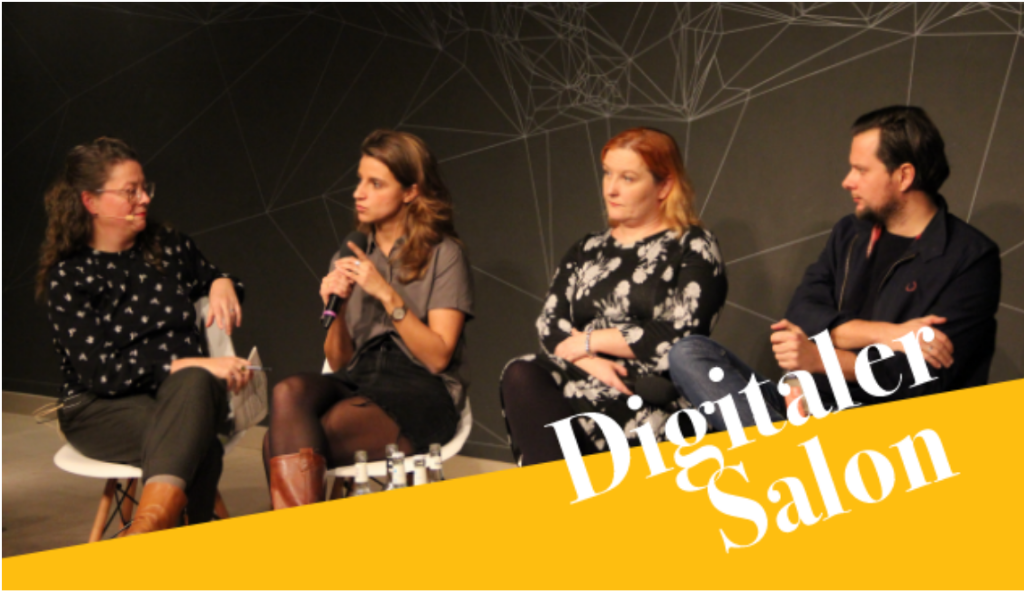
Einmal im Monat laden wir ausgewählte Gäste ein, um gemeinsam mit dem Publikum über die Auswirkungen der Digitalisierung auf die Gesellschaft zu sprechen.
NEWSLETTER
Erfahren Sie als Erstes über neue Events und spannende Forschungsergebnisse.