
Making sense of our connected world

#TaxTheRich: How do members of the German Bundestag debate wealth taxation on social media?
This week could bring fresh momentum to the debate over wealth taxation in Germany, as the German Federal Constitutional Court considers the inheritance tax. But how important is wealth taxation for members of the Bundestag in their social media communication, and how do they argue about it? An empirical study provides answers. Overall, wealth taxation is not among the most prominent topics, but it is receiving growing attention. While economically left-wing parties mainly make value-based arguments in favour of higher taxation, right-wing parties respond by pointing to possible damage to the economy.
When SPD leader and Federal Finance Minister Lars Klingbeil called for higher taxes on the wealthy last year, the debate over wealth taxation gained considerable momentum. Since then, however, the issue has faded somewhat from the spotlight. That could change this week: the Federal Constitutional Court is considering whether business and private assets may be treated differently for inheritance tax purposes. This is likely to put wealth taxation back in the public spotlight.
A few own a lot
Germany is one of the world’s largest economies. Yet wealth is distributed very unequally. The poorer half of the population owns almost nothing, while much of the country’s wealth is concentrated in the hands of a few. Specifically, the bottom ninety percent of Germans hold only around one-third of all private wealth – roughly the same share as the richest one percent alone (Schröder et al. 2020). The number of billionaires is another indication of this concentration: With 184 billionaires, Germany ranks third worldwide. And that number continues to rise. Against this backdrop, the question arises whether large private fortunes should contribute more to financing public services through taxation, and how political actors are framing this debate.
Wealth taxation on social media
What role does wealth taxation play in the public communication of members of the Bundestag (MP)? And how is the debate on wealth and inheritance tax conducted there? Studies show that the public responds to higher taxation of large fortunes with moderate to strong approval, and that at least no strong resistance can be identified (Schechtl and Tisch 2024, Bellani et al. 2024). Economically left-leaning parties take up this sentiment and make corresponding tax reforms a central campaign promise (Beznoska and Hentze 2025). However, how this is reflected in MPs’ everyday social media communication has so far been studied only to a limited extent. In a study (Nenno & Lorenz-Spreen 2025), I examined exactly this: how have members of the Bundestag communicated about wealth taxation on Facebook, Instagram and X since 2017? In the following, I present some key findings.
Not a perennial issue, but on the rise
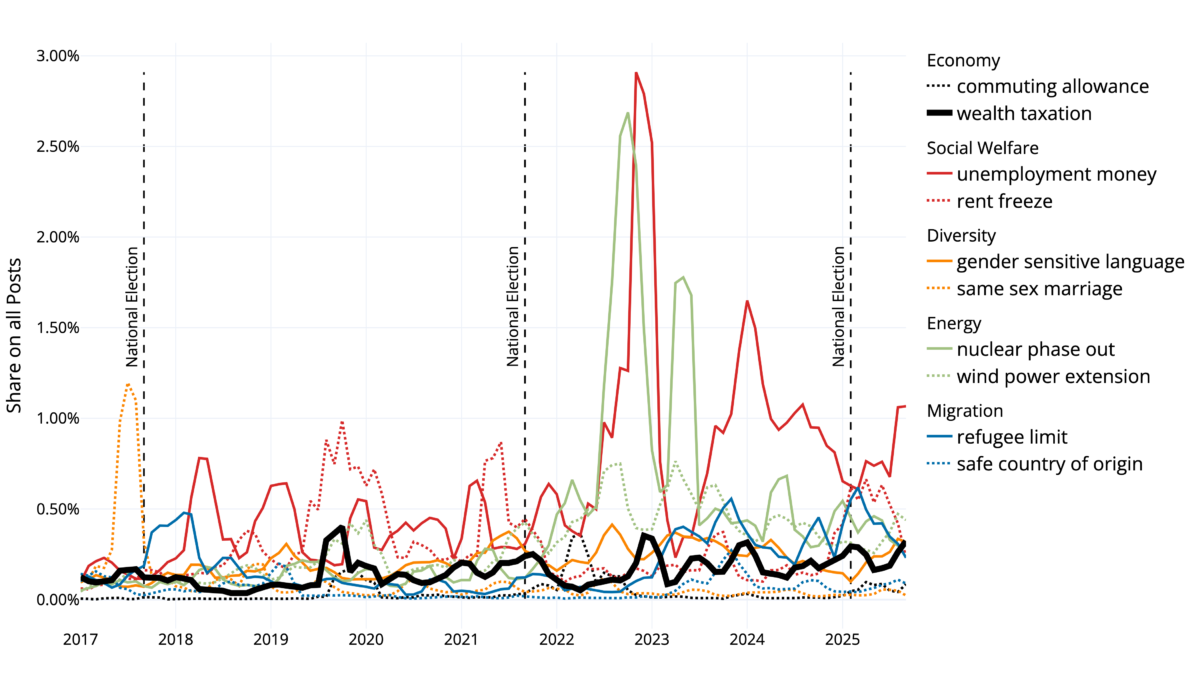
To get a sense of the importance of wealth taxation in MPs’ social media discourse, I used a large language model (LLM) to identify this and other topics in MPs’ posts and analyse their development over time (Fig. 1). The first impression is that wealth taxation is neither among the most discussed topics nor a marginal one. Unemployment money (Bürgergeld/Hartz IV) and the nuclear phase-out are by far the most frequently discussed issues among the reference topics, while wealth taxation, much like gender-sensitive language, sits in the middle range. More interesting than the absolute frequency, however, is the trend: it is edging upwards. Before the 2021 federal election, 0.14% of all posts addressed this topic; during the period of the traffic-light coalition, the figure had risen to 0.18%, and since the most recent election to 0.23%. This development was driven above all by economically left-wing parties, which argue for higher taxation of large fortunes.
At first glance, the figures may seem low, but only to a limited extent. Given the enormous diversity of topics on social media, even a ubiquitous issue such as unemployment money accounted for less than 3% of all posts at its peak. By that measure, wealth taxation is certainly present, and increasingly so.
Talking past each other: pro and contra without common ground
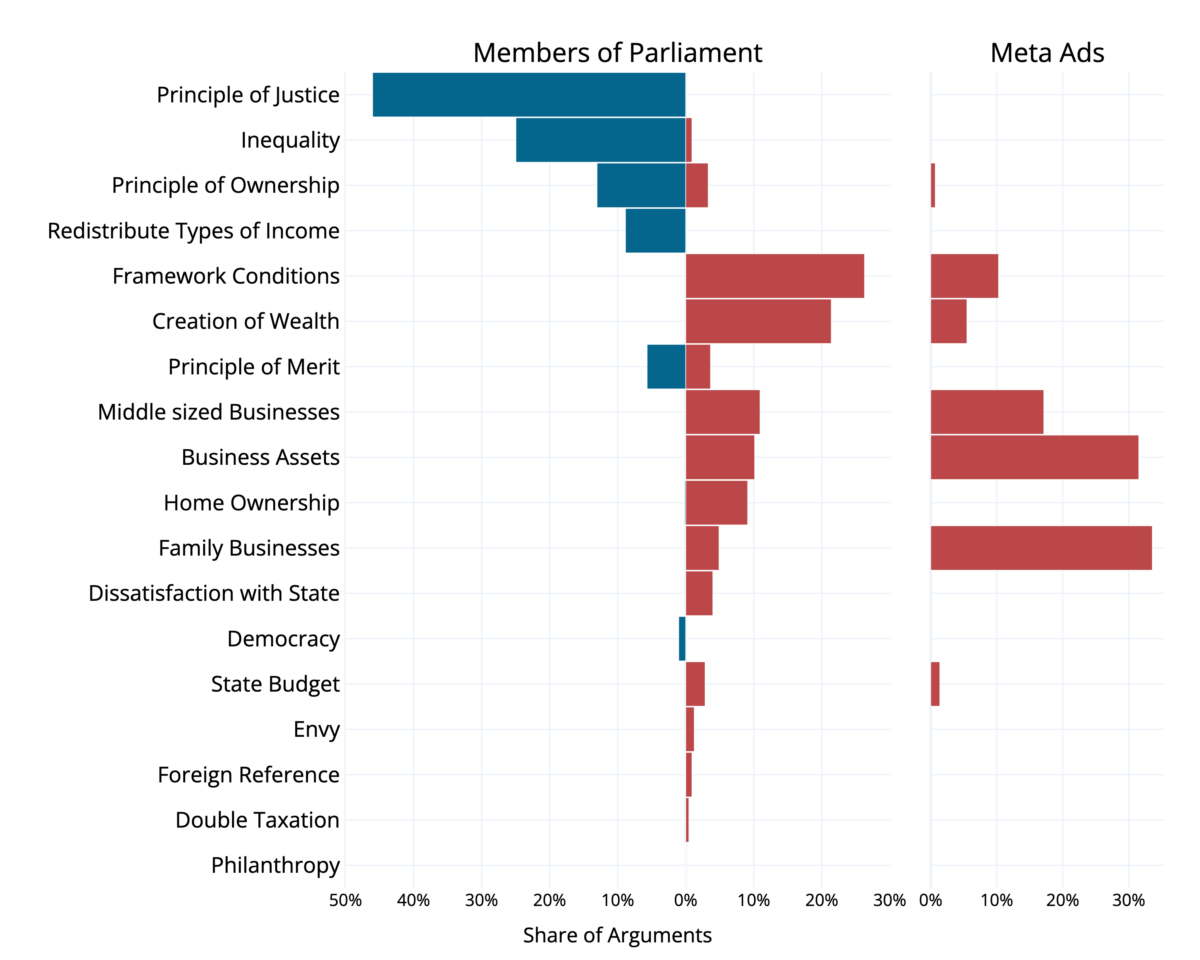
Now that we know how important the issue is in the social media communication of members of the Bundestag, it is worth taking a closer look at the substance: what arguments do MPs make for or against higher taxation of wealth (Fig. 2), and do they engage with one another? To examine the arguments, I again used a large language model and adopted the types of argument identified in earlier research (Beckert and Arndt 2017, Linartas 2023).
The central finding is clear: the pro and contra arguments hardly overlap at all. The arguments made by economically left-wing parties such as Die Linke, the SPD, the Greens and Bündnis Sahra Wagenknecht in favour of higher taxation barely address the counterarguments put forward by conservative and right-wing parties (FDP, CDU/CSU, AfD), and vice versa. A different outcome would certainly have been conceivable. For most types of argument, there are versions that can be used both for and against strict taxation. For example, under the argument type “principle of ownership”, one can argue in favour of taxation on the grounds that the wealthy should contribute to financing the state, but also against it, as an illegitimate state intervention in private property. It would therefore have been possible for both sides to use the same types of argument, only in opposite directions. Instead, they are simply talking past each other.
The arguments in detail
What is being argued in substantive terms? The pro side argues in a fairly unified way: wealth in Germany is extremely unequally distributed, this is unjust, property entails social responsibility, and wealth in Germany is taxed far too lightly compared with income. The contra side, by contrast, argues primarily in economic terms, with different emphases depending on the party. The CSU focuses above all on protecting home ownership, the FDP, and also the CDU, stress the negative economic consequences and the difficulty of implementation, while the AfD additionally raises the question of whether the state uses tax revenues effectively at all.
In addition to MPs’ posts, I also analysed paid advertising by lobby organisations on Facebook and Instagram. The Family Businesses Association (Familienunternehmer) was particularly active, campaigning against higher wealth taxation in the run-up to the 2021 federal election (see Anhold 2025 for more information). In substantive terms, its position is close to those of the CDU and FDP, but with a stronger focus on the specific risks for small and medium-sized enterprises.
Left-wing parties preach to the choir
There is the expression “preaching to the choir”. It refers to trying to convince someone of something they already believe. This may be exactly what is happening here. Voters for left-wing parties, on average, perceive economic inequality as considerably more problematic than voters for right-wing parties (Häusermann et al. 2025). The value-based arguments of left-wing parties — injustice, social responsibility, redistribution — therefore primarily speak to their own camp. Whether these arguments also reach people who already see the issue differently and view inequality as less of a problem is less clear.
Yet there are certainly starting points for reaching a broader audience. For example, left-wing parties could benefit from engaging more strongly with the concrete economic aspects of a wealth tax, rather than focusing on questions of social justice. Does lower wealth taxation necessarily lead to stronger economic growth? Research findings suggest the opposite (Hope and Limberg 2022). Do wealthy individuals flee abroad with their companies as soon as inheritance or wealth taxes rise? Existing laws make this considerably more difficult (Trautvetter 2024). And are large fortunes really the result of individual achievement? In Germany, inheritances play a disproportionately large role (Alvaredo et al. 2017, Tisch and Ischinsky 2023), while social mobility has demonstrably declined (Bönke et al. 2024). Such findings are subject to uncertainty, but they provide left-wing parties with a basis for rebutting economic counterarguments and thus for being heard beyond their own bubble.
References
Alvaredo, F., Garbinti, B., & Piketty, T. (2017). On the Share of Inheritance in Aggregate Wealth: Europe and the USA, 1900–2010. Economica, 84(334), 239–260. https://doi.org/10.1111/ecca.12233
Anhold, K. (2025, February 17). Die Lobby der Superreichen: Gegen die Besteuerung von Reichtum. LobbyControl. https://www.lobbycontrol.de/reichtum-und-einfluss/die-lobby-der-superreichen-gegen-die-besteuerung-von-reichtum-119795/
Beckert, J., & Arndt, H. L. R. (2017). Verdient – Unverdient. Der öffentliche Diskurs um die Erbschaftssteuer in Deutschland und Österreich. Berliner Journal für Soziologie, 27(2), 271–291. https://doi.org/10.1007/s11609-017-0346-2
Bellani, L., Ceolotto, S., Elsner, B., & Pestel, N. (2024). The political fallout of air pollution. Proceedings of the National Academy of Sciences, 121(18), Artikel e2314428121. https://doi.org/10.1073/pnas.2314428121
Beznoska, M., & Hentze, T. (2025). Erbschaft- und Vermögensteuer in den Wahlprogrammen (No. 5/2025; IW Policy Paper). https://www.iwkoeln.de/studien/martin-beznoska-tobias-hentze-erbschaft-und-vermoegensteuer -in-den-wahlprogrammen.html
Bönke, T., Harnack-Eber, A., & Lüthen, H. (2024). The Broken Elevator: Declining Absolute Mobility of Living Standards in Germany. SSRN Electronic Journal. https://doi.org/10.2139/ssrn.4704655
Häusermann, S., Palmtag, T., Zollinger, D., Abou-Chadi, T., Walter, S., & Berkinshaw, S. (2025). Politicizing Inequality in Times of Sociocultural Conflict: How New Left and Far Right Voters Think About Inequality. Politics & Society, 00323292251353374. https://doi.org/10.1177/00323292251353374
Hope, D., & Limberg, J. (2022). The economic consequences of major tax cuts for the rich. Socio-Economic Review, 20(2), 539–559. https://doi.org/10.1093/ser/mwab061
Linartas, M. B. (2023). Different But Same. The Role of the Inheritance Tax and Narratives of the Economic Elites for Wealth Inequality in OECD States.: The Cases of Mexico and Germany. https://refubium.fu-berlin.de/handle/fub188/45276
Nenno, S., & Lorenz-Spreen, P. (2025). How German members of parliament debate wealth taxation on social media (No. xn2bu_v1). SocArXiv. https://doi.org/10.31235/osf.io/xn2bu_v1
Schechtl, M., & Tisch, D. (2024). Tax principles, policy feedback and self-interest: Cross-national experimental evidence on wealth tax preferences. Socio-Economic Review, 22(1), 279–300. https://doi.org/10.1093/ser/mwac071
Schröder, C., Bartels, C., Göbler, K., Grabka, M. M., & König, J. (2020). MillionärInnen unter dem Mikroskop: Datenlücke bei sehr hohen Vermögen geschlossen – Konzentration höher als bisher ausgewiesen. DIW Wochenbericht. https://doi.org/10.18723/DIW_WB:2020-29-1
Tisch, D., & Ischinsky, E. (2023). Top Wealth and Its Historical Origins: Identifying Entrenched Fortunes by Linking Rich Lists over 100 Years. Socius, 9, 23780231231192774. https://doi.org/10.1177/23780231231192774
Trautvetter, C. (2024). Keine Angst vor Steuerflucht. 100 Jahre demokratische Gegenmaßnahmen und ihre Bedeutung für die Besteuerung deutscher Milliardenvermögen. Oxfam Deutschland e. V., Netzwerk Steuergerechtigkei. https://www.oxfam.de/system/files/documents/oxfam_netzwerk_steuergerechtigkeit_2024_keine_angst_vor_steuerflucht_final.pdf
This post represents the view of the author and does not necessarily represent the view of the institute itself. For more information about the topics of these articles and associated research projects, please contact info@hiig.de.

Sami Nenno

You will receive our latest blog articles once a month in a newsletter.

Enforcing the Digital Services Act: A cat & mouse game?
The Digital Services Act has been in force for two years. Is it working as expected? A look at enforcement progress and geopolitical influences.

AI startups made in Germany — Specialisation instead of computing power
What role do AI startups play in Germany’s position in the global AI race? This article draws on ten interviews to offer insight into their business models.

Brave new world of work? Narratives on AI and the future of work
A comparison between German and US-American public discourse shows how different narratives on AI shape the future of work.