
Making sense of our connected world

Tick-box democracy: What a polling booth reveals about our personal beliefs
The way people in Germany perceive democracy has changed significantly in recent years. With the “Democracy in Germany Polling Booth”, we set out to investigate people’s perception of democracy and engage with them in conversation about it. Rather than voting for political parties or politicians, twelve statements on democracy were put to the vote. In this blog post, we present our learnings from analysing the 131 completed ballot papers, as well as the methodological design of the experiment. These are initial trends drawn from a non-representative but insightful sample. A detailed account of the methodology and the full results, along with their limitations, can be found in our accompanying discussion paper.
Recent studies have shown that attitudes towards democracy in Germany have changed in recent years. There has been an increase in authoritarian tendencies and scepticism towards state institutions, as well as a shift in trust in democratic processes. For example, the MOTRA Monitor 2024/25 shows that around 14 per cent of the German population now distance themselves from the fundamental principles of a liberal democracy based on the rule of law (Kemmesies et al., 2026). Meanwhile, the Mitte Studie 2024/25 reveals that only 6.6 per cent of respondents completely reject far-right statements, marking the lowest proportion ever recorded (Zick et al., 2025).
Understanding democracy belief systems
Such shifts cannot be explained by approval ratings alone. It may not be a rejection of democracy as a whole, but rather a matter of personal beliefs about how we experience and evaluate democracy. For example, international research shows that people’s understanding of democracy varies depending on the importance they place on free elections, the rule of law, social justice or direct participation (Ferrín Pereira et al., 2023). Therefore, the question is if it is personal beliefs rather than rational reasons that are central to how people understand democracy?
This is precisely where the “Democracy in Germany Polling Booth” comes in. We piloted this at HIIG as part of the “Long Night of Sciences 2026”, building on the concept of “Democracy Belief Systems” (Hernández, 2019). According to this framework, beliefs about democracy are political values and ideas organised into democratic beliefs. Belief systems are therefore composed of various democratic beliefs, which are measured along two dimensions. Firstly, they are expectations of how democracy should be, and how it functions in reality. Therefore, this concerns a very personal view on democracy and an assessment of how well the current political system complies with this view. Secondly, these expectations and assessments are organised as a coherent system and do not exist in isolation from one another. As these highly individual assessments are informed by people’s experiences of the political system, it may be the case that people support some democratic principles more strongly than others (Ferrer et al., 2025)
The voting booth as a practical experiment
To gain a better understanding of people’s personal democratic beliefs, we have created an interactive, participatory experiment, namely the “Democracy in Germany Polling Booth”. The idea is that asking people abstract questions about their attitudes (for example, “What do you think about democracy?”) is not sufficient to uncover their personal beliefs about democracy. What is needed instead is for people to be confronted with specific statements that can be agreed or disagreed with, and an opportunity to assess these statements individually. With the voting booth, we piloted this kind of intervention.
To this end, we created a ballot paper for visitors to the Long Night of Science to fill in. Instead of voting for parties and politicians as usual, visitors could “vote” for deliberately controversial statements about democracy. For each statement, visitors could write comments, regardless of whether they agreed with it or not. They could also express their aspirations and feelings regarding democracy in two free-text fields at the end of the ballot paper.
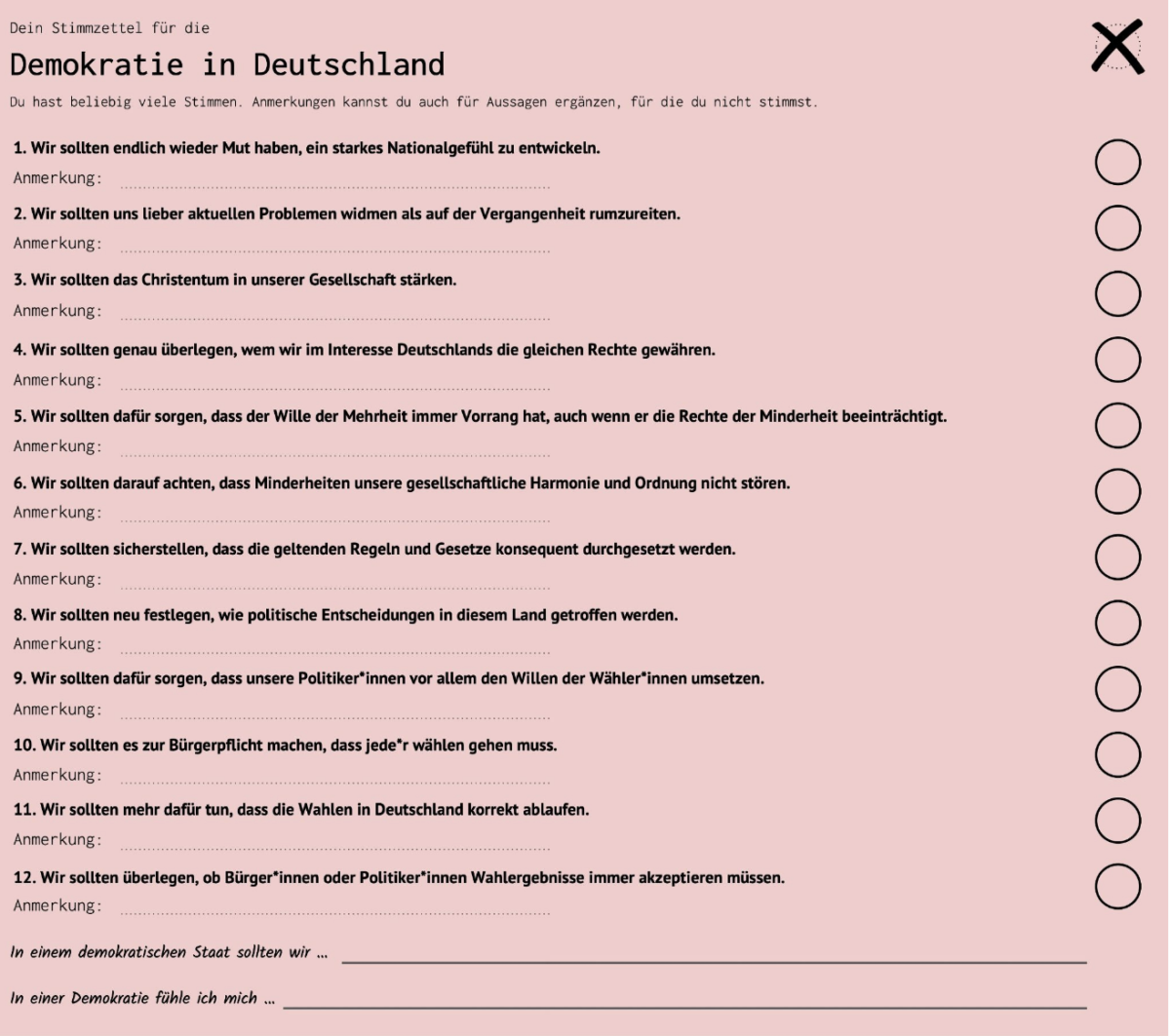
The statements on the ballot paper were based on nationwide studies of political attitudes, satisfaction with democracy, and societal prejudices, such as the MOTRA Monitor 2024/25, Leipziger Autorismusstudie 2024, Mitte Studie 2024/25, and Menschen in Deutschland 2025. From these studies, we identified the attitudes that would serve as points of contention for our voting booth, using an empirical approach, developed twelve thought-provoking statements for the ballot paper (the exact procedure is described in this discussion paper).
When developing the statements, we made sure that they would encourage reflection without discriminating against or suggesting general suspicion towards individual social groups. Discussions with visitors to the “Democracy in Germany Polling Booth” have shown just how differently the statements on the ballot paper can be interpreted. The extent to which someone interprets a statement as conservative or progressive, attributes it to a particular political camp or simply reads it as an objective description varied greatly. This could be because an individual’s interpretation depends largely on their own perspective. Additionally, the historically rooted connotations of individual terms, such as ‘national sentiment’, also play a significant role.
Admittedly, with only 131 completed ballot papers, it is not possible to speak of a representative cross-section of society. Nevertheless, the findings from this experiment highlight areas where further research is needed.
Election results at a glance
The initial analysis of voting behaviour can already provide some insight into how voters perceive democracy. The high level of support for consistently enforcing existing rules and laws (statement 7) and ensuring the will of voters is carried out (statement 9) shows how important these aspects are to the visitors to the Long Night of the Sciences. However, it is not just the raw approval rates that are revealing. The average rate of comments stands at 40 per cent, indicating a strong willingness to engage more deeply with the statements on the ballot paper. The number of comments varies not only between individual statements, but also depending on whether the statement is agreed with. This allows for further nuanced insights into visitors’ perspectives.
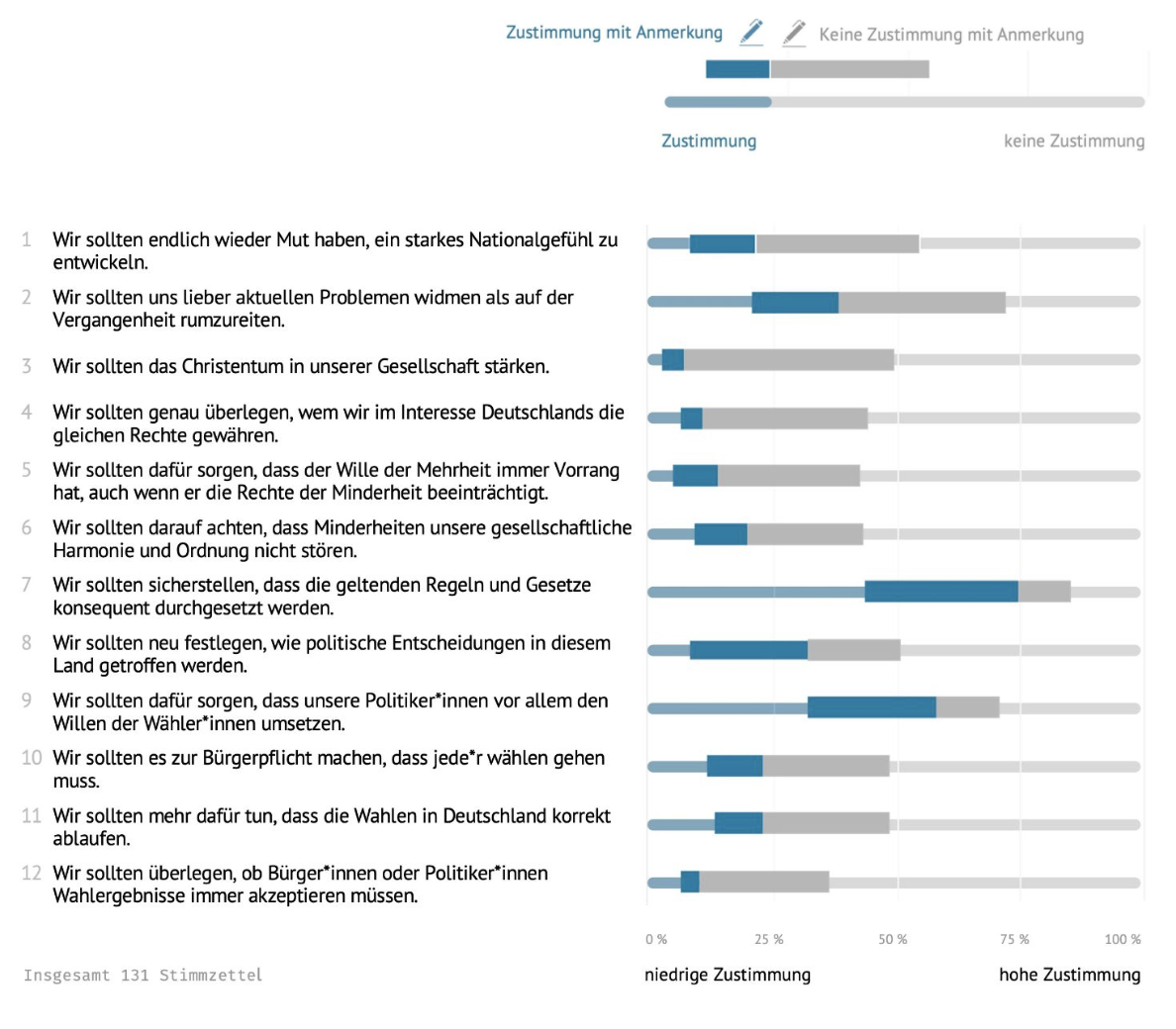
It is particularly striking that comments were predominantly made when respondents did not vote for a statement. The exceptions to this were the statements concerning the implementation of existing rules and laws (Statement 7), political decision-making (Statement 8), and the implementation of the voters’ will (Statement 9). This suggests that certain statements elicit a particularly strong reaction from visitors, which is reflected in the comments.
More consensus than dissent
Examining voting behaviour across the entire ballot paper reveals a fairly consistent pattern of agreement and non-agreement. As most visitors display relatively similar voting behaviour, the significant divergence of opinions on the statement regarding the implementation of the voters’ will (statement 9) is all the more striking. This is consistent with the findings of other studies, which have shown that societies are often less divided than they are sometimes portrayed in the media (Kumkar, 2025). Rather than a division across society as a whole, there are signs of pluralism on specific issues, and the results of our sample fit into this pattern. These so-called “trigger points” – individual aspects of these topics where agreement turns into emotionally charged conflict and dissent – are societal breaking points (Mau et al., 2023; Faas, 2025).
These trigger points could therefore serve as a good starting point for further social and academic debate. Our experiment shows that a broad consensus on democratic values remains: respect, diversity, tolerance, fairness, security and freedom are repeatedly cited – at least on ballot papers – as being central to democracy. Focusing more strongly on these contentious issues could therefore encourage more substantive debate on individual topics.
Research on democracy requires genuine discourse
However, such a debate should not end with mere agreement or disagreement, but should go one step further. Firstly, trigger points cannot be reduced to a black-and-white debate; they require a more in-depth exchange, such as the one we have initiated with the “Democracy in Germany Polling Booth”. Secondly, personal beliefs play a crucial role: our experiences of the democratic system and how we evaluate them are central to our perception of democracy. Specific references to personal experiences were made repeatedly in both the comments and the free-text fields. For example, one person wrote that they “currently feel uncertain because they cannot predict which direction the majority is moving in and whether it is the ‘right’ one” (own translation). Another person stated that, “as an artist, [they] feel more or less ‘valued’” (own translation).
In this respect, sending out questionnaires alone, as has been done in some studies (Hernández, 2019; Pickup et al., 2024), is insufficient for research on democracy. Genuine dialogue on the ground is needed to understand citizens’ beliefs about democracy. This was demonstrated by the visitors’ keen interest in discussion during the Long Night of Science. Contrary to our original assumption that people would vote independently, the voting booth quickly evolved into a space for intensive discourse on democracy in Germany throughout the entire duration of the event.
Where do we go from here?
The findings from the “Democracy in Germany Polling Booth”, which we have presented, merely represent initial impressions and trends. Our experimental setting appears to confirm the initial hypothesis that personal beliefs play a central role in how people understand democracy. Indeed, our understanding of democracy appears to be significantly shaped by personal beliefs. We must therefore recognise that different democratic principles take on different meanings as a result of these beliefs (Ferrer et al., 2025). These often unconscious trade-offs between democratic principles could influence individual voting decisions, which is why a pluralistic society could benefit from open debate on these beliefs.
This, in turn, requires robust findings. The data from the “Democracy in Germany Polling Booth” can be analysed in greater depth for that. Also, the methodological approach can be adapted for use in larger-scale studies, thereby validating it and broadening its scope. Integrating empirical research with democratic theory can contextualise individual beliefs about democracy. This could provide scientifically sound ways of addressing the current challenges facing democracy in Germany, such as authoritarian tendencies, growing scepticism towards state institutions, and shifting levels of trust in democratic processes. In the long term, this could also help to better contextualise these challenges from a scientific perspective.
A detailed account of the methodology, the full results and their limitations can be found in our accompanying discussion paper.
References
Decker, O., Kiess, J., Heller, A., & Brähler, E. (Hrsg.). (2024). Vereint im Ressentiment. Autoritäre Dynamiken und rechtsextreme Einstellungen. Psychosozial-Verlag. https://www.boell.de/sites/default/files/2024-11/leipziger-autoritarismus-studie-2024-vereint-im-ressentiment-autoritaere-dynamiken-und-rechtsextreme-einstellungen.pdf
Faas, T. (2025). Polarisierung trotz Stabilität. Wähler:innen in Deutschland und ihr Blick auf Demokratie, Medien, Themen und Parteien im Lichte der CNEP-Studien 2017, 2021, 2024. Arbeitsstelle Politische Soziologie der Bundesrepublik Deutschland. https://www.polsoz.fu-berlin.de/polwiss/forschung/systeme/empsoz/forschung/ressourcen-Projekte/Abschlussbericht_OBS_CNEP_2025.pdf
Ferrer, S., Hernández, E., Prada, E., & Tomic, D. (2025). The value of liberal democracy: Assessing citizens’ commitment to democratic principles. European Journal of Political Research, 64(4), 2018–2038. https://doi.org/10.1111/1475-6765.70021
Ferrín Pereira, M., Hernández, E., & Landwehr, C. (2023). Understandings and Evaluations of Democracy Topline results from rounds 6 and 10 of the European Social Survey. European Social Survey ERIC. https://europeansocialsurvey.org/sites/default/files/2023-10/TL013_Democracy-English.pdf
Hernández, E. (2019). Democracy belief systems in Europe: Cognitive availability and attitudinal constraint. European Political Science Review, 11(4), 485–502. https://doi.org/10.1017/S1755773919000286
Kemmesies, U., Wetzels, P., Austin, B., Büscher, C., Hutter, S., Richter, T., Rieger, D., Grube, F., & Sobota, S. (Hrsg.). (2026). MOTRA-Monitor 2024/2025. Motra Monitoringsystem und Transferplattform Radikalisierung. https://doi.org/10.57671/ISBN.978-3-911329-02-6_2026_MOTRA
Pickup, M., Groenendyk, E. W., Kimbrough, E. O., Stephenson, L., Bourgeois, L. F., & Harell, A. (2024). Is This How Democracy Dies? Democratic Norms and Belief Systems in Mass Publics (SSRN Scholarly Paper Nr. 5045673). Social Science Research Network. https://doi.org/10.2139/ssrn.5045673
Kumkar, N. (2025). Polarisierung. Berlin: Suhrkamp.
Mau, S., Lux, T. & Westheuser, L. (2025). Triggerpunkte: Konsens und Konflikt in der Gegenwartsgesellschaft. Berlin: Suhrkamp.
Wetzels, P., Farren, D., Fischer, J. M. K., Brettfeld, K., Endtricht, R., & Richter, T. (2025). Erste Ergebnisse der repräsentativen MOTRA-Befragung „Menschen in Deutschland“ 2025 (MiD 2025). Subjektive Wahrnehmungen gesellschaftlicher Entwicklungen und Zustände sowie diesbezügliche Trends in Deutschland seit 2021. Universität Hamburg. https://doi.org/10.25592/uhhfdm.18053
Zick, A., Küpper, B., Mokros, N., Eden, M., & Schröter, F. (Hrsg.). (2025). Die angespannte Mitte: Rechtsextreme und demokratiegefährdende Einstellungen in Deutschland 2024/25. Dietz. https://www.fes.de/index.php?eID=dumpFile&t=f&f=159776&token=c046b94f061255878306ea930e95f1bee68c200
This post represents the view of the author and does not necessarily represent the view of the institute itself. For more information about the topics of these articles and associated research projects, please contact info@hiig.de.

Ann-Kathrin Watolla, Dr.

Maurice Stenzel, Dr.

You will receive our latest blog articles once a month in a newsletter.

#TaxTheRich: How do members of the German Bundestag debate wealth taxation on social media?
Germany’s Constitutional Court is reviewing the inheritance tax. A study shows how members of the Bundestag argue online.

Enforcing the Digital Services Act: A cat & mouse game?
The Digital Services Act has been in force for two years. Is it working as expected? A look at enforcement progress and geopolitical influences.

AI startups made in Germany — Specialisation instead of computing power
What role do AI startups play in Germany’s position in the global AI race? This article draws on ten interviews to offer insight into their business models.