Making sense of our connected world

Digital streetwork: Social work between TikTok and Telegram
Social work no longer happens only on the street. It also takes place on Instagram, TikTok, Discord or Telegram. The approach is called digital streetwork: professionals reach out to young people and other hard-to-reach groups where they already spend time online, on a voluntary, anonymous and free basis. An original survey counts 36 such projects in German-speaking countries, ranging from preventing extremism to advising migrants. Yet many depend on fixed-term funding and on platform rules they have no say in. What would digital streetwork need to play a lasting role in protecting young people online, alongside age limits and reporting centres?
Ada is new in Berlin. For months she has been unable to find a flat, so she sleeps on friends’ sofas. Experts call this hidden homelessness. On Instagram, she comes across the project SOMS – Social Media Streetwork, where a social worker listens to her, exchanges messages with her, offers emotional support and shows her concrete ways to look for housing.
Ada is one of many young people who need support during a period of transition, for instance between school and vocational training, when leaving their parents’ home or while working out who they are. Social work offers them a wide range of support that is guaranteed by law. It is low-threshold, meaning easy to access, as well as confidential and non-judgemental, and it is often available exactly where young people are. Today that includes the internet, in the form of digital streetwork.
Why social work is moving online
Young people are mostly online without adult guidance, and that carries communication risks. According to a survey for North Rhine-Westphalia’s state media authority, almost 40% of 14- to 24-year-olds who have encountered hate speech have been targeted themselves (Landesanstalt für Medien NRW, 2024). A study for the health insurer DAK-Gesundheit found that more than one in five 10- to 17-year-olds use social media in a risky way (DAK-Gesundheit, 2026). This means they show individual warning signs. They occasionally lose control over their use, put social media before other things or carry on despite negative consequences. That alone does not make them addicted. At the same time, almost one in two 16- to 30-year-olds in Germany feel lonely (Steinmayr et al., 2024), and problematic social media use is associated with lower well-being (Boniel-Nissim et al., 2024).
Conventional support services such as counselling centres or social welfare offices, known in Germany as Regeldienste, assume that people will come to them. Digital streetwork aims to reach precisely those who do not take this step. Experts call them “hard-to-reach” groups (Höllmüller, 2022). They often know little about counselling and support, or they cannot or do not want to seek it out. Conversely, the welfare state has so far not approached them systematically. They include young people not in education, employment or training (NEETs), among them “disconnected” young people who do not receive basic income support either and have therefore fallen through the cracks of every support system (Mögling et al., 2015, p. 10). Other such groups include migrants, people with mental illness, homeless people and other vulnerable groups, meaning those who are socially disadvantaged.
What is digital streetwork?
Digital streetwork brings outreach social work (Krafeld, 2004) to social media. Instead of waiting for someone to walk into a counselling centre, social workers approach people themselves. People do not have to take the first step. The services are nonetheless voluntary, anonymous and free of charge. If someone says no, that is always accepted.
The term was coined by practitioners. Youth social work projects that moved online used it to describe what they did: “For us, digital streetwork means […] we practise youth (social) work, and we do so online” (Dinar & Heyken, 2017, p. 13, own translation). The term online streetwork emerged later to describe a very similar practice. It captures the idea in an image of professionals seeking contact “on the digital streets of their online world” (Hagemeier & Stuiber, 2020, p. 7, own translation). The two terms are often used interchangeably. This article uses digital streetwork throughout.
Three projects in practice
Three examples show how varied these services are. One tackles extremism, one supports migrants and one is open to any concern young people may have.
The first, streetwork@online, is run by the association AVP e. V. and works against extremism. Its online streetworkers are active where young people come across extremist content: on Instagram, TikTok, Telegram, Facebook and Discord. Through their own posts and by contacting young people directly, they aim to prevent religiously motivated extremism and online hate and to strengthen democratic values.
Minor Digital, run by the Berlin-based organisation Minor, reaches a very different group of people. They include migrants, refugees and workers in precarious sectors such as live-in care (carers who live in the household of the person they look after) or the meat industry. Its professionals are active in multilingual online communities, mostly on Facebook. They advise in languages including Arabic, Turkish, Ukrainian, Russian and Bulgarian on residence status, the recognition of qualifications, employment and social rights and everyday life in Germany.
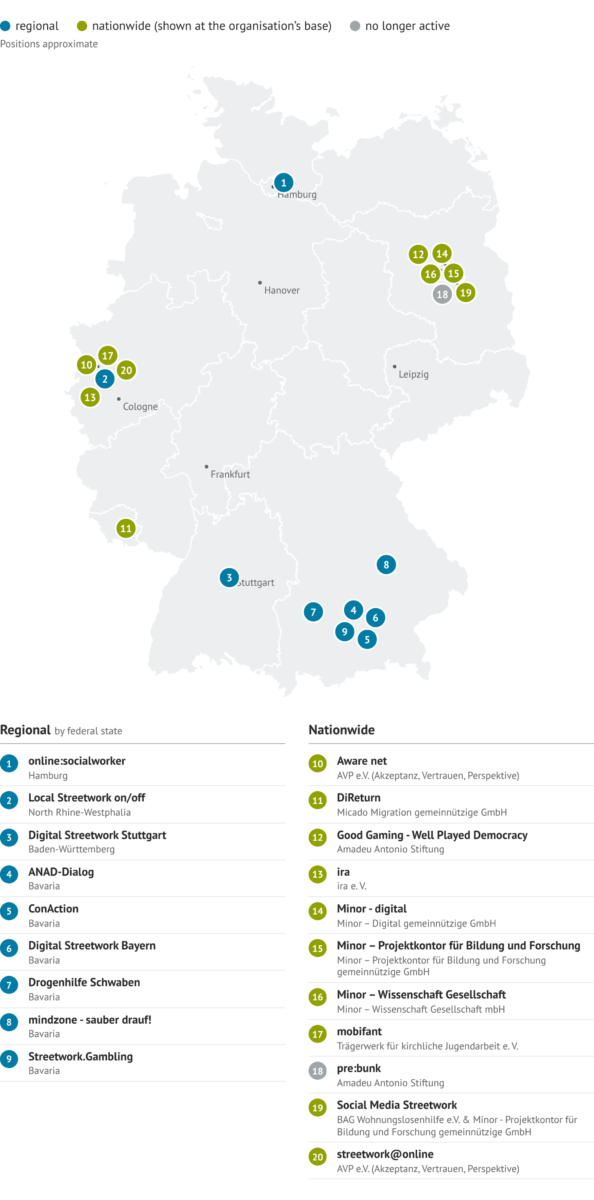
Digital Streetwork Bayern, a project of the Bavarian Youth Council (Bayerischer Jugendring), works without a fixed thematic focus. Its professionals approach young people and young adults aged 14 to 27 on social media, gaming and forum platforms. There they offer free, confidential and, if desired, anonymous counselling on everyday problems and mental health crises, and refer people to local support services. These three projects are only a snapshot. A map by the research project DEMO-WORK shows where else in Germany such services exist (Figure 1). DEMO-WORK gathers knowledge from research and practice to support professionals working in digital streetwork.
Growth since the pandemic
Since the first approaches emerged in 2015, digital streetwork has spread quickly across German-speaking countries. The main driver was the COVID-19 pandemic, when many areas of social work turned to digital communication to keep reaching their target groups (Stieler & Kühne, 2024, p. 20). For a long time, however, it was unclear how far digital streetwork had developed and spread.
The figures in this article therefore come from an original survey. Conducted in 2023 and updated in 2026, it provides the first systematic overview of the field. Online searches for “Digital Streetwork” and “Online Streetwork” returned more than 270,000 results, which were narrowed down to 52 websites for closer analysis. The count includes only services that support people in precarious circumstances via social media, free of charge and anonymously, and that use these terms to describe themselves.
From 22 to 36 projects
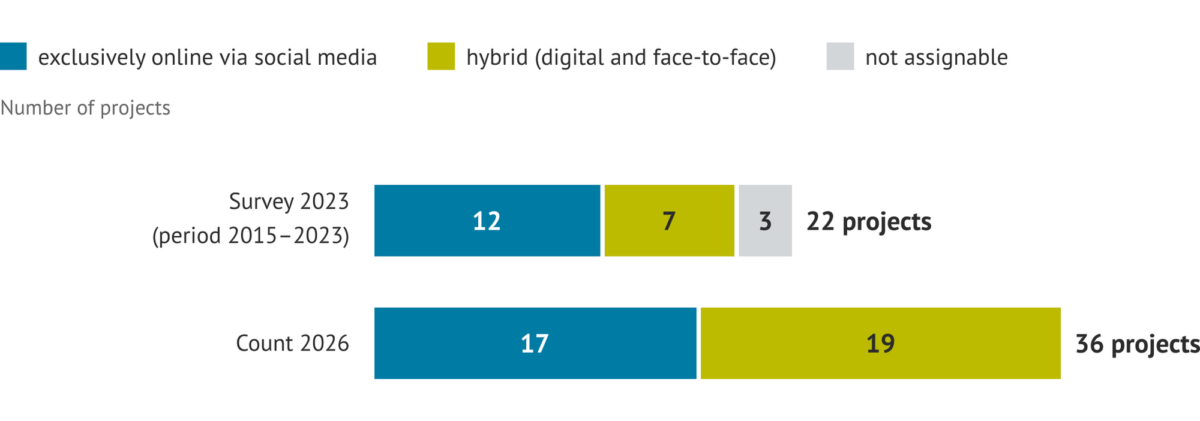
The first survey, covering 2015 to 2023, found 22 projects, most of them in Berlin. Of these, 12 worked exclusively online and 7 in a hybrid way, meaning they added digital services to existing face-to-face counselling. For 3 projects, this could no longer be determined.
The updated count for 2026 covers 36 projects: 30 in Germany, 4 in Austria and 2 in Switzerland. Part of this increase reflects a broader search. The geographical picture has shifted too. Most location-based projects are now in Bavaria (nine). Another 10 projects operate nationwide or across several federal states, often with target groups related to migration. Of the 36 projects, 17 work exclusively online. The remaining 19 work in a hybrid way. They combine digital streetwork with existing structures such as online counselling, open child and youth work (youth clubs and drop-in centres) or youth social work. According to the information available online, 23 projects are currently active, 5 have ended and the status of 8 is unclear.
Three forms of digital streetwork
Behind the figures are very different services, which fall into three forms. They differ in where the educational work is anchored and which problems it addresses. As shown below, this makes a big difference to how they are funded.
Table 1: Three forms of digital streetwork. Source: own survey, 2026.
Topics: more migration, more open youth work
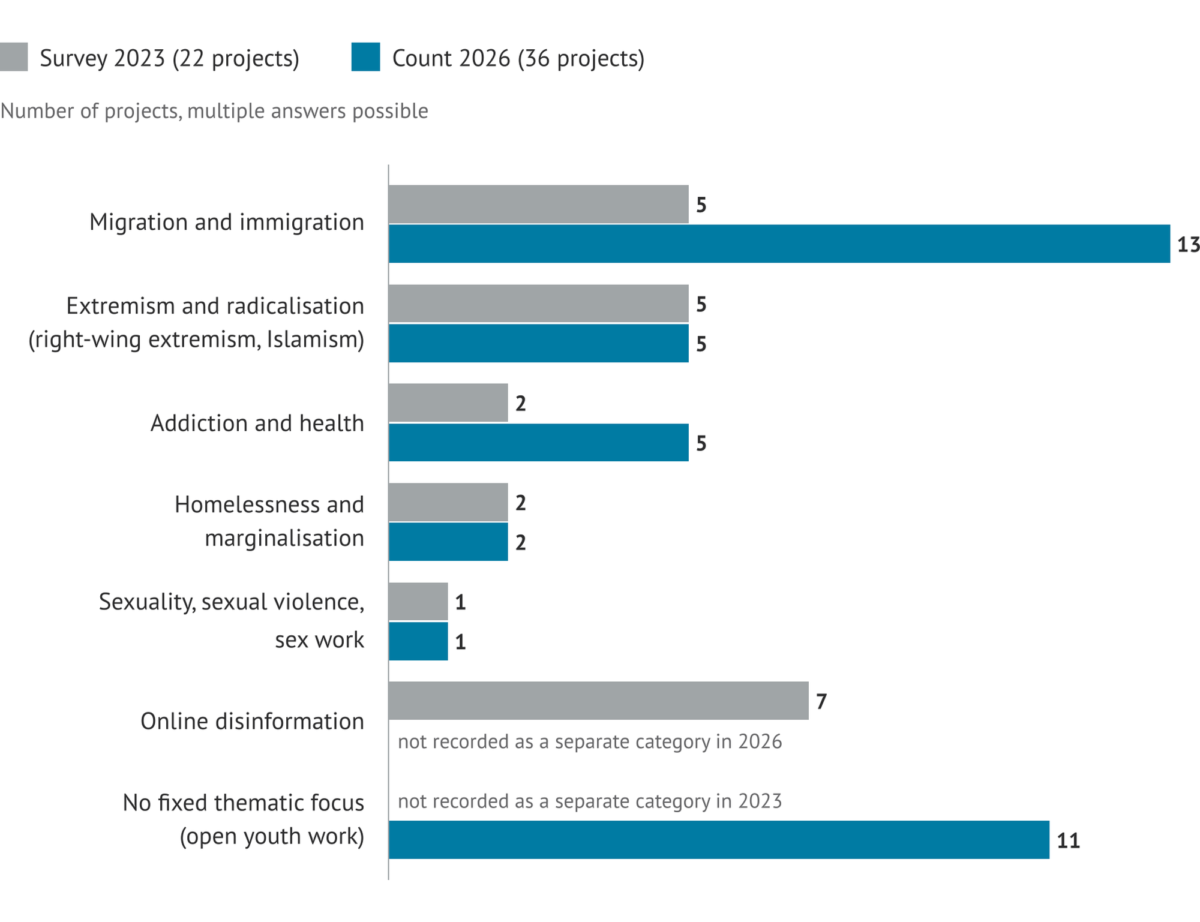
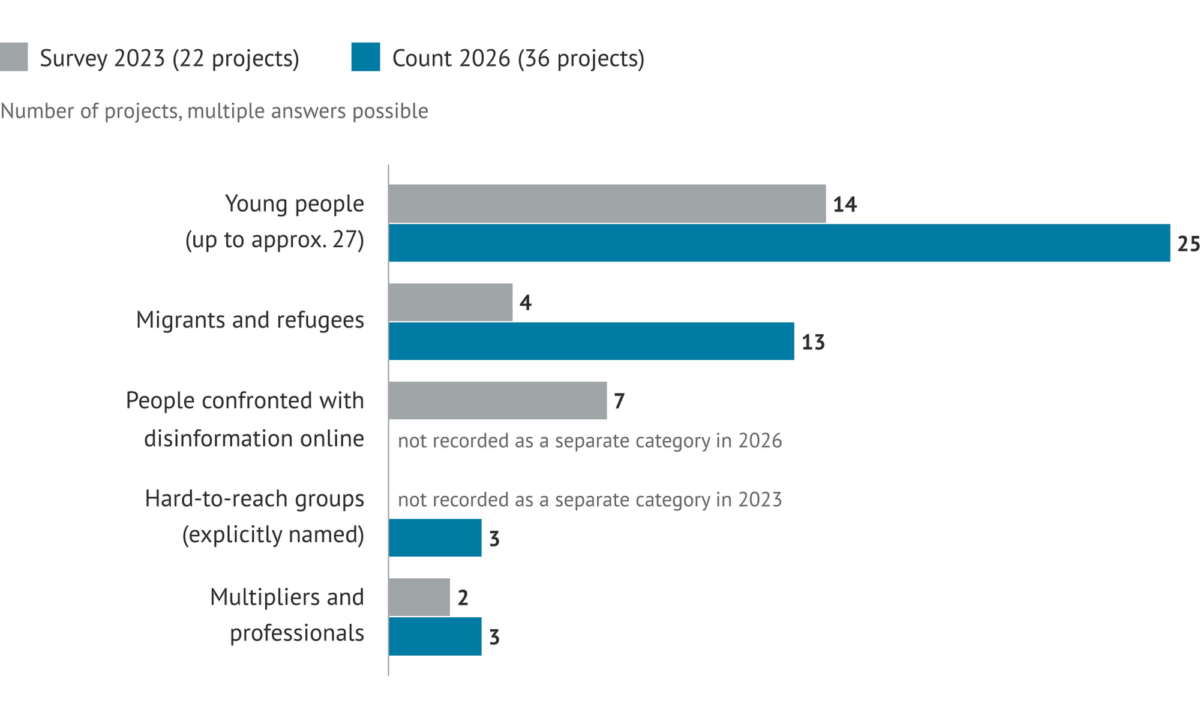
The projects cover a wide range of social problems, often several at once. In 2023, dealing with online disinformation was still the most common topic (seven projects)..
The 2026 count shows a clear shift. With 13 projects, migration is now by far the largest topic. It includes advice for EU migrants and third-country nationals (people from countries outside the EU), questions about work and settling in, and return counselling. Extremism and radicalisation remain stable at 5 projects. Addiction and health, by contrast, has grown (five projects) and now covers substance use, gambling and, for the first time, eating disorders. Homelessness (2 projects) and sex work, prostitution and human trafficking (1 project) remain niche topics. A new, sizeable group of 11 projects has no fixed thematic focus. They see themselves as providing open outreach youth (social) work online and respond to young people’s concerns on any topic.
Target groups: mainly young people
The shift in topics is also reflected in the target groups, although their core remains the same. As in 2023 (14 of 22 projects), most projects focus on young people. In 2026, 25 of the 36 projects are aimed at adolescents and young adults, usually aged 12 or 14 to 25 or 27. Services for migrants have grown markedly (13 projects). Smaller groups include young people who use substances in risky ways, are at risk of eating disorders or have a gambling addiction, as well as young people at risk of homelessness and people in prostitution and sex work.
Platforms: Instagram leads, TikTok and Telegram catch up
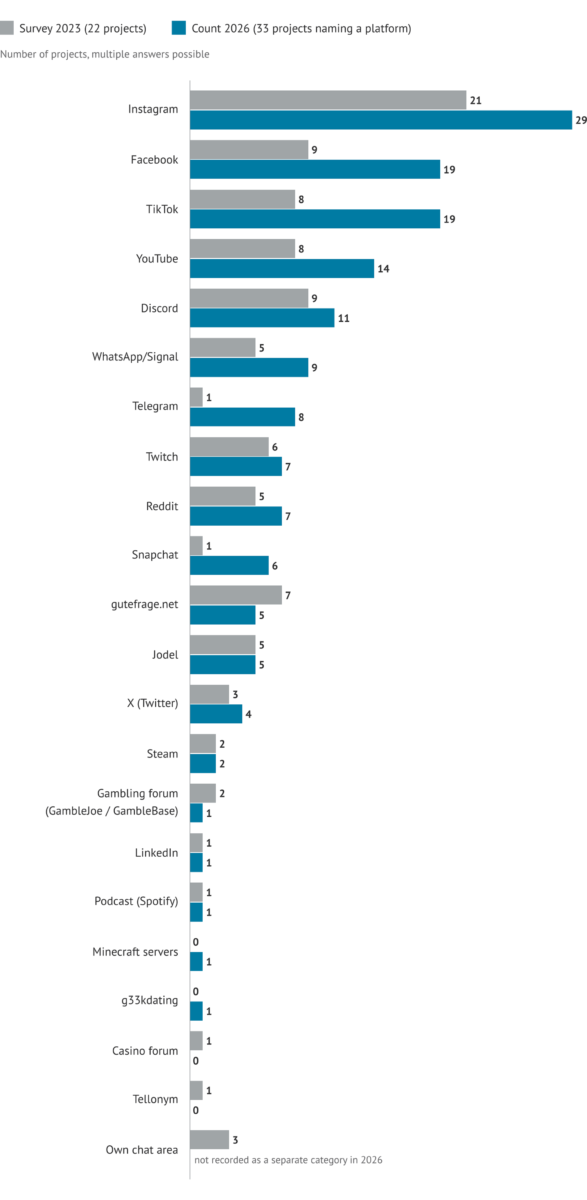
Which platforms the projects use depends closely on these target groups. In 2023 they used 20 different platforms, most often Instagram, followed by Discord, Facebook, TikTok and YouTube. All of them are widely used in Germany (Koch, 2023).
In 2026 the number is again around 20. Instagram remains the central venue, used by 29 of the 33 projects that name a platform. TikTok and Facebook follow with 19 projects each, then YouTube with 14 and Discord with 11. TikTok has therefore gained ground. Messaging apps such as WhatsApp and Telegram (eight projects each) and Signal (three projects) matter mainly for migration-related services. In 2023, only one project used Telegram. The projects also continue to use specialised spaces. These include community and Q&A platforms such as Reddit, the location-based chat app Jodel and the German Q&A site gutefrage.net, gaming environments such as Twitch, Steam and Minecraft servers, and topic-specific platforms such as GambleBase for gambling or platforms related to sex work.
What digital streetwork achieves
What do these figures mean for practice and policy? Three findings stand out. Digital streetwork is growing and diversifying, it is already active where young people go when bans apply, and it often stands on shaky ground. First, what the approach achieves. Its potential lies in low-threshold, anonymous and flexible access, which allows early contact before problems become entrenched. Interviews with 20 digital streetworkers conducted for this research also show that media literacy education (help with using digital media safely) is always part of the work. It covers issues such as data protection, disinformation, cyberstalking or digital extortion (Dinar, 2026). TThis applies even when topics such as addiction or loneliness take centre stage.
A typical case shows what this looks like in practice. A young woman has dropped out of her apprenticeship in catering. Almost by chance, she comes across a mention of a digital streetwork service in a Reddit forum. She plucks up her courage and writes to the social workers. In the conversation, it emerges that one of the reasons she left was a colleague who had taken private photos of her and wanted to share them without her consent. The streetworker helps her secure evidence and draft an email telling the colleague to stop. She also puts the young woman in touch with a contact at the local youth employment agency (Jugendberufsagentur) and points her to other online services that specialise in digital violence.
Digital streetwork is therefore almost always media literacy education as well. This aspect is just rarely mentioned in a project description and even more rarely in a funding application. For the debate on protecting young people online, this means that the skills needed to help them deal with online risks already exist in these projects. They simply go unseen.
What puts the projects at risk
This work is not only invisible but also often on an insecure footing. How secure a project is depends on where it is based (Table 1). If digital streetwork belongs to an existing service such as a Youth Migration Service (Type A) or mobile youth work (Type B), that institution helps to carry the project. Projects created specifically for new problems online (Type C), by contrast, usually depend on fixed-term pilot funding. The figures show how fragile the field is. Of the 36 projects recorded, 5 have already ended, and for 8 it is unclear whether they still exist. Responsibility is a further problem. Funding and responsibility for social work usually lie with municipalities and the federal states (Länder). Yet anyone who counsels online reaches people far beyond these boundaries, and it is then often unclear who should cover the costs.
For practice and funding, this opens up several options, each with its own advantages and drawbacks.
- Documenting the media literacy work within digital streetwork more thoroughly would make it more visible, improve funding prospects and anchor media literacy education in everyday social work. It means more documentation work, but the effort can pay off.
- New projects could work more closely with mainstream services from the outset. This would increase their chances of continuing beyond the end of their funding and becoming established in the long term.
- For services that counsel across regions, funding could span several federal states or the whole country. It would match the digital reach of the work but affect the division of responsibilities between the federal government, the states and municipalities. Since German-language services exist across Germany, Austria and Switzerland, a joint structure for networking and exchange would also be an option.
All of these options rest on the same principle. Outreach work online should be understood as a permanent part of welfare provision, particularly child and youth welfare, rather than as a pilot scheme.
No say in platform rules
There is also a second dependency. Digital streetwork takes place on platforms whose rules the projects have no say in. The survey shows how strong this dependency is: 29 of the 33 projects that name a platform are active on Instagram. The platforms decide at their own discretion whether a project account is officially verified. In the algorithmically sorted feeds of social networks, projects often remain invisible or have to produce a lot of content and spend money on advertising simply to reach their target group. Working with content creators, people who produce their own content for their followers, is also unregulated so far. Such collaboration could build a bridge to professional support on issues such as loneliness or psychological distress. But it carries risks, including the commercialisation of help and a lack of professional standards. Here too, two options emerge, each with its own trade-offs.
The first would be recognised status for digital streetwork professionals in their dealings with the platforms, modelled for instance on “trusted flaggers” under the EU’s Digital Services Act (DSA). Platforms must give priority to notices of illegal content from these recognised bodies (Regulation (EU) 2022/2065, Art. 22). Such status could give projects visibility and direct contacts at the platforms. It does, however, raise new questions. Who would grant it, and how would the projects stay independent of the platforms?
A second option would be shared professional standards for working with content creators, for example on labelling paid content and referring people to specialist services. These could combine reach with professional quality, but they would require the projects to agree on common rules. Both options rest on the principle of recognising support services on social media as part of the digital infrastructure, especially for young people, rather than merely as users the platforms tolerate.
Digital streetwork as a necessary complement for safer online lives
Despite these hurdles, the field is growing, most strongly in open youth (social) work online (Figure 3). This makes the approach relevant to the current debate on protecting young people online, which has gained momentum since summer 2026. In June 2026, an expert commission on child and youth protection in the digital world, set up by Germany’s Federal Ministry of Education, Family Affairs, Senior Citizens, Women and Youth, recommended a nationwide “Kinderonlinewache”. This would be a child-friendly reporting centre run by the security authorities. The commission also recommended tiered age limits for social media. At the same time, it stresses that vulnerable groups should be reached through relationship-based work and low-threshold access (Expertenkommission, 2026). Since December 2025, young people under 16 in Australia have not been allowed to hold social media accounts. Early experience there suggests that bans partly shift use to messengers and gaming environments (Meineck, 2026), which are spaces where social workers are already active online.
This is precisely the gap that digital streetwork can fill. Reporting and prohibition address risks and breaches of the law. Outreach work online, by contrast, offers relationships, counselling and guidance in the everyday online lives of young people and other disadvantaged groups. Yet it can only play this complementary educational role in the long term with reliable structures beyond fixed-term pilot funding, recognised status with the platforms and shared professional standards. Equally important would be a clear mandate for preventive work and media literacy education early on and in the places where communication risks arise, independent of public order services such as the Kinderonlinewache.
Conclusion: A sought-after approach with an uncertain future
Kinderonlinewache, age limits, pilot funding: it all sounds like administration and a long way from young people looking for help in a chat. Yet the survey shows how close to them this help has come. In just a few years, a handful of individual projects has grown into a field of work in its own right, with 36 projects that advise on many topics and can be reached on all major social networks. At the same time, its foundations remain unstable. Many positions are fixed-term, and Instagram and the like decide how visible the projects’ content is.
What is at stake between TikTok and Telegram, then, is whether young people online mainly encounter algorithms or also people who listen to them and support them in finding their way and in times of crisis. That question, however, is not decided on the platforms but in funding programmes and budgets. Ada found such a person on Instagram. The next Ada will only find one if the position still exists by then.
References
Boniel-Nissim, M., Marino, C., Galeotti, T., Blinka, L., Ozoliņa, K., Craig, W., Lahti, H., Wong, S. L., Brown, J., Wilson, M., Inchley, J., & van den Eijnden, R. (2024). A focus on adolescent social media use and gaming in Europe, central Asia and Canada [Ein Blick auf Social-Media- und Gaming-Nutzung Jugendlicher in Europa, Zentralasien und Kanada] (Health Behaviour in School-aged Children international report from the 2021/2022 survey, Bd. 6). WHO Regional Office for Europe. https://iris.who.int/server/api/core/bitstreams/f787fae6-e564-477c-a0e6-d54f24b38f0b/content
DAK-Gesundheit. (2026). Zwischen Fortnite, TikTok und ChatGPT: Mediennutzung, Risiken und neue Nutzungstrends bei Kindern und Jugendlichen in Deutschland (Mediensuchtstudie, Ergebnisbericht 2025/2026; durchgeführt vom DZSKJ am Universitätsklinikum Hamburg-Eppendorf). https://www.dak.de/mediensucht
Dinar, C. (2026). Praxis als Arbeit mit Sozialen Medien. In S. Haupt, T. Kallenbach, & N. Klevermann (Hrsg.), Ein Glossar zum Praxisverständnis Sozialer Arbeit: Praxis als gemeinsame Spurensuche (S. 257–259). Verlag Barbara Budrich. https://doi.org/10.3224/84743411
Dinar, C., & Heyken, C. (2017). Digital Streetwork: Pädagogische Interventionen im Web 2.0. Amadeu Antonio Stiftung. https://www.amadeu-antonio-stiftung.de/wp-content/uploads/2018/08/digital_streetwork_web-1.pdf
Expertenkommission „Kinder- und Jugendschutz in der digitalen Welt“. (2026). Entwicklung stärken, Verantwortung übernehmen: Kurzversion der Handlungsempfehlungen. Bundesministerium für Bildung, Familie, Senioren, Frauen und Jugend. https://www.bmbfsfj.bund.de/bmbfsfj/themen/kinder-und-jugend/expertenkommission-kinder-und-jugendschutz-in-der-digitalen-welt/handlungsempfehlungen-der-expertenkommission-kinder-und-jugendschutz-in-der-digitalen-welt–290244
Hagemeier, A., & Stuiber, A. (2020). Online-Streetwork: Ein erweiterter Ansatz der aufsuchenden Jugendarbeit & Radikalisierungsprävention. streetwork@online, AVP e.V. https://streetwork.online/wp-content/uploads/2023/12/SWO_Broschuere_2020_ONLINE.pdf
Höllmüller, H. (2022, 2. August). Hard-to-reach. In socialnet Lexikon. socialnet. https://www.socialnet.de/lexikon/Hard-to-reach
Koch, W. (2023). Soziale Medien werden 30 Minuten am Tag genutzt – Instagram ist die Plattform Nummer eins: Ergebnisse der ARD/ZDF-Onlinestudie 2023. Media Perspektiven, (26). https://www.ard-zdf-onlinestudie.de/files/2023/MP_26_2023_Onlinestudie_2023_Social_Media.pdf
Krafeld, F. J. (2004). Grundlagen und Methoden aufsuchender Jugendarbeit: Eine Einführung. VS Verlag für Sozialwissenschaften. https://doi.org/10.1007/978-3-663-08051-0
Landesanstalt für Medien NRW. (2024). Hate Speech: forsa-Studie 2024. https://medienanstalt-nrw.de/fileadmin/user_upload/Forschung/forsa_Hassrede/LFMNRW_Hatespeech_forsa_2024.pdf
Meineck, S. (2026, 6. August). Australien zieht Bilanz: Fünf erste Lehren aus dem Social-Media-Verbot. netzpolitik.org. https://netzpolitik.org/2026/australien-zieht-bilanz-fuenf-erste-lehren-aus-dem-social-media-verbot/
Mögling, T., Tillmann, F., & Reißig, B. (2015). Entkoppelt vom System: Jugendliche am Übergang ins junge Erwachsenenalter und Herausforderungen für Jugendhilfestrukturen. Vodafone Stiftung Deutschland. https://www.vodafone-stiftung.de/wp-content/uploads/2019/06/Entkoppelt-vom-System.pdf
Steinmaier, D., Kalkmann, M., & Stapf, T. (2018). Digital Streetwork in der Asyl- und Migrationsberatung. Informationsverbund Asyl und Migration & Minor – Projektkontor für Bildung und Forschung. https://minor-kontor.de/wp-content/uploads/2018/08/Minor_DigitalStreetwork_18-08-29.pdf
Steinmayr, R., Schmitz, M., & Luhmann, M. (2024). Wie einsam sind junge Erwachsene im Jahr 2024? Ergebnisse einer repräsentativen Umfrage. Bertelsmann Stiftung. https://doi.org/10.11586/2024085
Stieler, M., & Kühne, S. (2024). Online-Streetwork: Arbeitsfeld und Methode in der Sozialen Arbeit. e-beratungsjournal.net, 20(2), 19–33. https://doi.org/10.48341/7pwr-jk45
Verordnung (EU) 2022/2065 des Europäischen Parlaments und des Rates vom 19. Oktober 2022 über einen Binnenmarkt für digitale Dienste (Gesetz über digitale Dienste). (2022). Amtsblatt der Europäischen Union, L 277. https://eur-lex.europa.eu/eli/reg/2022/2065/oj
This post represents the view of the author and does not necessarily represent the view of the institute itself. For more information about the topics of these articles and associated research projects, please contact info@hiig.de.

Christina Dinar

A monthly selection of new blog posts and videos by email.

Platform governance
How can the goals of corporations and the values of society be reconciled on online platforms?

Data governance
How can the technical, organisational and regulatory mechanisms of data sharing and use serve the public interest?

Artificial intelligence and society
How can we better understand the complex and reciprocal relationship between AI systems and social processes?

Digitalisation and sustainability
How can technology be used responsibly, taking into account social, economic and ecological dimensions?

Digital future of the workplace
How will digital organisation, digitalisation, and AI in the workplace transform the world of work?