

Impact AI Method: FAQs
The Impact AI Method measures the impacts of artificial intelligence “for good” use cases that aim to serve for instance sustainability and/or public interests. It was developed by Impact AI, a transdisciplinary research project at the Alexander von Humboldt Institute for Internet and Society (HIIG) in Berlin, together with Greenpeace Germany and Economy for the Common Good (ECOnGOOD). Over five years, the team led by Dr. Theresa Züger is applying the method AI use cases, which are independent of the project.
The Impact AI Method is designed for a holistic yet practice-oriented impact assessment of AI use cases that are already in operation (not research projects or prototypes). Focusing on contributions to a sustainable and just development, the framework aims to provide evidence on the implications a given AI use case has for people, society and the planet.
While the method has a broad scope and combines different normative principles, including sustainability (and its three dimensions), the public interest, human rights and democratic values. Despite this breadth one of its key goals is to be feasible in practice. It is conducted by or at least with external third parties. The complete Impact AI Method can be found online.
The overall rapid increase in the use of artificial intelligence (AI) is linked to various initiatives that propose to utilise ‘AI for Good’. We have observed that, even with the best intentions, at the ‘AI for good’ use cases today sometimes fail to consider whether their tools are sustainable or fully aligned with the public interests, human rights and democratic values. Further, the actual, relevant, implications of their work are not always obvious, or properly measured holistically.
The goal of the Impact AI Method is to close this gap and to systematically evaluate the actual implications of these AI projects to make them transparent and measurable. In doing so, the method aims to contribute to a more accurate understanding of the impacts and achievements, but also harms, of individual AI use cases. At the same time, the assessments generate evidence and concrete outputs for stakeholders who wish to use AI sustainably and to serve the public interest.
To develop our method, we combined and extended existing assessment approaches and complemented them with documentation frameworks, ethical guidelines or those from international institutions, international standards, and other principles for ethical AI. The development of the method benefited from the more practical knowledge of our partners Greenpeace Germany and ECOnGOOD. The development process was also accompanied by our project council, made up of eleven leading experts from various disciplines and professional backgrounds. Overall, our development process is iterative, which allows us to refine and improve the method further by applying it to actual cases and continuously collecting feedback.
The impact assessment consists of seven steps:
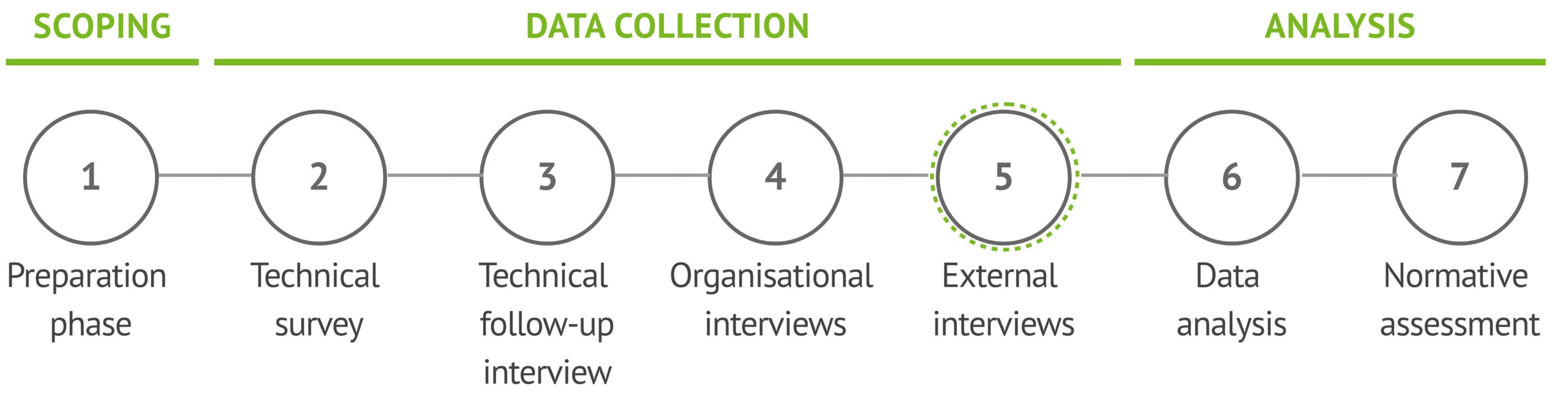
1. Preparation phaseWe begin with a preliminary conversation with the relevant AI use case. This gives us an initial opportunity to gain an overview of how the respective project teams work and implement AI systems AI-systems, and to assess whether the use case is suitable for the impact assessment. To do so, we have developed a “pre-questionnaire” which covers the most important questions to be asked in this first exchange. To better contextualise the AI use case and tailor the interview guides to it we also carry out desk research, request documentation from the assessed use case and conduct briefing interviews with experts in the respective application domain.
2. Technical surveyThe organisation completes a survey on the technical details of its AI system and covers the AI system, model and dataset. It is based on the AIMS template (AIMS stands for “Artificial intelligence through the lens of multidimensional sustainability”; for more information see State, Züger & Winter 2026).
3. Technical follow-up interviewFollowing the survey, we conduct an interview with a technical lead to validate and understand the system's architecture.
4. Organisational interviewsWe conduct three semi-structured interviews with the organisational lead of the AI project, covering various topics relating to the AI use case's impacts, governance and sustainability as well as potential harms and their mitigation.
5. External impact interviewsWhere possible, we conduct additional interviews with users or other relevant parties to complement the collected data with further perspectives.
6. Data analysisWe analyse the collected data using qualitative content analysis.
7. Normative assessmentFinally, we assess the results against 25 assessment criteria.
Want to take a closer look? The complete method, including the technical survey and all interview guides, is freely available.
The assessment catalogue comprises 25 criteria, each linked to specific assessment questions. Many of these criteria overlap with the UN’s principles on the ethical use of AI within the UN system. The catalogue of the assessment criteria and assessment questions can be found online.
We define one meta-level criterion which brings together several other criteria and ultimately seeks to answer the following questions:
| Meta-level criterion |
| What implications does the AI use case have for people, society and the planet? And does its overall impact justify the claim to serve the public interest and/or sustainability? |
The remaining 24 criteria are organised in five clusters:
| Impact |
| 1 Objectives and realisation Can goals, outcomes and outputs of the AI project be defined clearly and plausibly following a clear impact logic? |
| 2 Impact achievements Is there convincing evidence supporting the claim that the project has achieved envisioned outcomes? |
| 3 Relevance of impact achievements Are these outcomes relevant achievements in the given targeted problem area? |
| 4 Potential harm and mitigation Does the AI system in any way potentially cause or exacerbate harm, whether individual or collective, and including harm to social, cultural, economic, natural, and political environments and how is this harm prevented or mitigated? |
| 5 Risk and harm management Are there appropriate procedures to assess and monitor potential harms? |
| Governance |
| 6 Necessity and proportionality Is the use of an AI system, including the specific AI method(s) deployed, justified, necessary and proportionate in the given context and does it not exceed what is necessary and proportionate to achieve envisioned outcomes? |
| 7 Accountability Are there clear roles of responsibilities to ensure accountability for the AI system, its impacts and liabilities? |
| 8 Decision processes and design Is the design and decision-making process for the AI system reflecting principles of public interest and sustainability? |
| 9 Inclusion, participation and co-design When designing, deploying and using AI systems, does the project take an inclusive, interdisciplinary and participatory approach? |
| Social sustainability |
| 10 IT security Are there organisational responsibilities and measures to identify, address and mitigate IT security risks throughout the AI system lifecycle to prevent where possible, and/or limit any potential or actual harm? |
| 11 Sovereignty and power relations Does the project contribute to shifting power in a democratic way (e.g. to civil society or marginalised groups) and support inclusive use and equal distribution of benefits and harms of the AI system? |
| 12 Accessibility Does the project convincingly describe efforts or create measures to create accessibility? |
| 13 Non-discrimination Does the project take appropriate measures to prevent bias, discrimination and stigmatisation of any kind, in alignment with fundamental rights? |
| 14 Data protection Are the rights of data subjects respected, protected and promoted throughout the lifecycle of the AI system according to applicable laws? |
| 15 Human oversight Does the design of the system ensure human oversight and human capability to oversee the overall activity of the AI system? |
| 16 Self-determined use Do users make a self-determined choice when and how to use the system? |
| 17 AI literacy Does the project describe efforts or concrete measures to improve AI literacy of people directly or indirectly impacted by the AI system? |
| 18 Open for validation and contestation Does the project provide sufficient transparency and openness for evaluation? |
| 19 Technical explainability Is technical explainability ensured, meaning that outputs by an AI system can be understood and traced by human beings? |
| 20 User transparency Is there public information about the AI system that is understandable to the user of this system? Are individuals meaningfully informed about the AI system that they use, when a decision is informed by or made based on AI algorithms? |
| Environmental sustainability |
| 21 Complexity, energy and emissions Does the project take sufficient consideration of the complexity, energy and emissions of the AI system, including, but not limited to, measures to reduce these? |
| 22 Natural resources Does the project take sufficient consideration of the resource use of their AI system? |
| Economic sustainability |
| 23 Model and dataset sharing Are the model and the dataset publicly shared, or are there good reasons not to share them, and did the project take measures to make it easy to use them? |
| 24 Future perspective and collaboration Are there efforts to establish collaboration and to sustain the project and the fulfilment of its objectives in the future? |
We assess the analysed data against 25 criteria relating to aspects of impact and governance as well as social, environmental and economic sustainability. Each criterion is linked to an assessment question (see the overview in question 5). For the criterion Risk and harm management, for example, we ask: Are there appropriate procedures to assess and monitor potential harms?
Based on the analysed data, we answer each question. The meta-level criterion is assessed only qualitatively. The other 24 criteria are rated on a five-point scale:
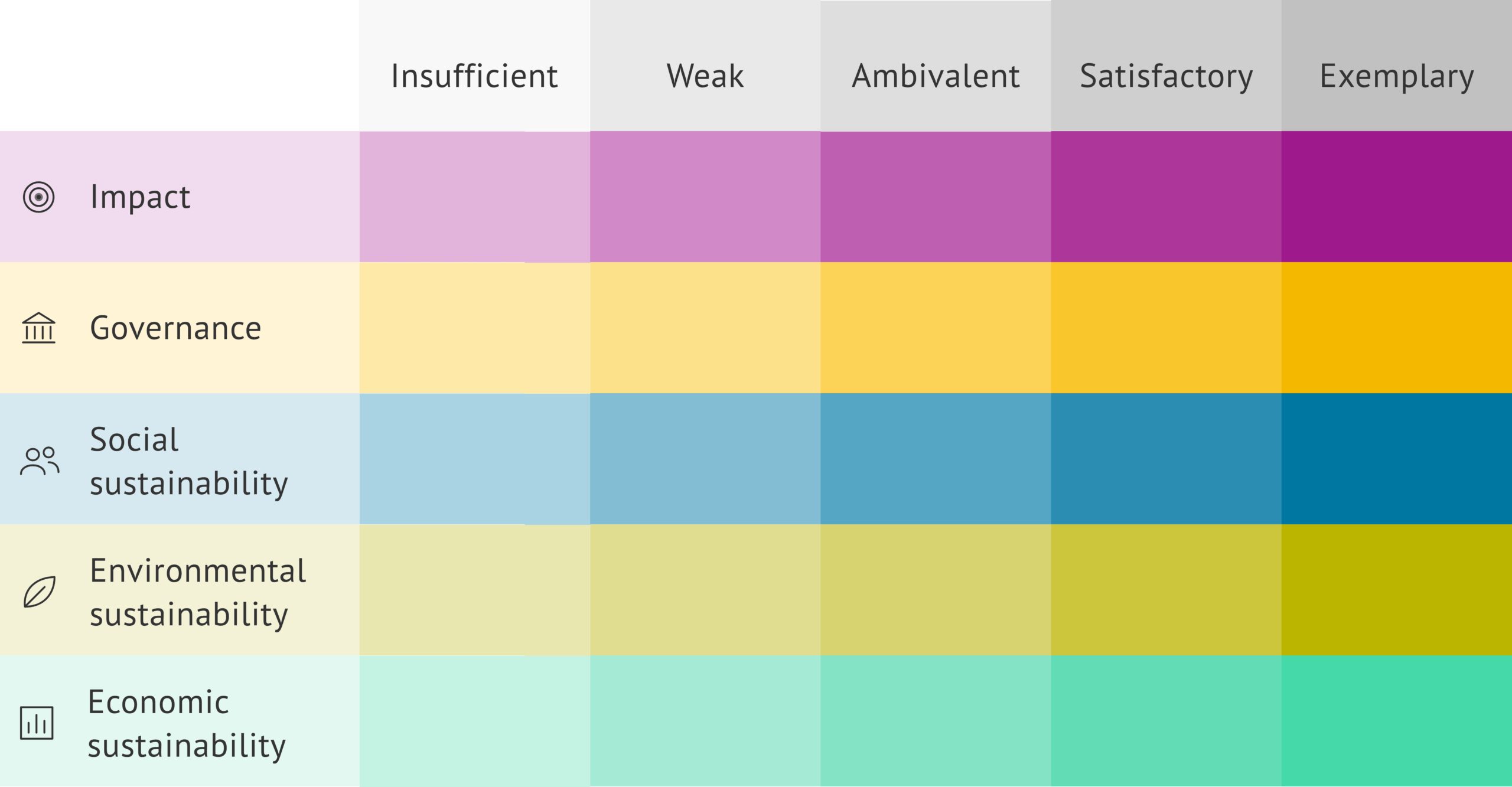
Together with the qualitative assessment, this rating forms the final assessment for each criterion. The full catalogue, including the sources for each criterion, is freely available.
After thoroughly analysing and assessing the data against the assessment criteria, we document our nuanced findings on all criteria in a report. In addition to contributing to public transparency on the use cases, we offer the participating AI use cases a learning experience, as they have the opportunity to receive feedback from our assessment as well as recommendations for improvement. Finally, the findings from individual or several use cases contribute to research findings on the reality of ‘AI for Good’ practices in academic and non-academic publications.
However, we are not a legal entity. We cannot attest to the legal compliance of the projects, nor do we offer any certification or award based on our assessment. We are not connected to any legal authorities, and the research collaboration is purely voluntary and non-commercial.
Unlike existing assessment approaches, the Impact AI Method covers a broad spectrum of relevant topics and combines different principles and assessment dimensions, thereby offering a holistic perspective on AI use cases and how they are implemented.. At the same time, the method incorporates the assessment of the project’s self-defined goals, how it realises them and the corresponding evidence.
Taking this broad approach, the method includes elements of a Fundamental Rights Impact Assessment (FRIA) or Data Protection Impact Assessment (DPIA) and takes into account how values such as human rights and democratic processes form part of the implementation of the AI use case. At the same time, the method assesses its contributions towards sustainability and the public interest by examining impact through a double lens that covers all levels of sustainability as well as the societal and design aspects that influence public interests. Furthermore, the method provides 'assessment catalogue' of 25 criteria for assessing the results. By translating the results into an easily understandable overview, we make them more comprehensible to a wider audience. With the Impact AI Method, we aim not only to assess the impacts of AI use cases but also to impact AI and its use in practice and in public debate.
We have developed the Impact AI Method with a focus on AI use cases which use AI with the intent to serve societal benefits, for “good” or sustainability and make an active public claim towards this societal goal. Overall, we are interested in projects by both non-profit and for-profit organizations. Currently, we only assess AI use cases which are fully operational and which are expected to be deployed for at least another year. The method can be applied to various AI models and is not specific to one domain, however, our capacities are limited by the size of our project and team.
Generally, participating projects contribute to more transparency and research on the impacts of AI projects for sustainability and public interest and thereby enrich an informed debate.
But also the projects themselves benefit greatly from the impact assessment process:
- Participation allows for many aspects of self-reflection that sometimes get lost in day-to-day business, it can give a coherent mandate to act for change internally.
- The survey on technical system details is provided to the use cases (as PDF and CVS) and can be used as documentation to increase transparency to users and other stakeholders.
- Participants get feedback from an independent, non-commercial outside perspective on many details of the project and potential room for learning and improvement in the areas of sustainability and public interest impact. Our assessment is oriented towards the UN’s principles for the ethical use of AI and therefore gives projects feedback that is aligned with these internationally grounded principles.
- Additionally, use cases might learn about their own projects by receiving feedback from interviews with users of their systems, which we will conduct, where possible. This feedback can also help to improve the design of the AI system and the project overall.
- Attention through impact assessment reports and academic publications.

For AI use cases
Organisations with AI use cases can apply to take part in an impact assessment in 2027. We welcome projects by non-profit and for-profit organisations. The method can be applied to various AI models and is not restricted to a specific domain. We are looking for fully operational AI use cases that are already in use in the field of ‘AI for Good’ (not research projects or prototypes). By this, we mean use cases that are intended to benefit society or serve sustainability and that actively and publicly claim to pursue this goal.
Requirements
The use case must be fully operational and already in use (not a research project or prototype) and expected to remain deployed for at least another year.
Please note
Our capacity is limited by the size of our project and team, so we are unable to assess all interested use cases.

For researchers, journalists and professionals
In summer/autumn 2027, we will organise the Impact AI Fellowship, which offers fellows the opportunity to learn the Impact AI Method and put it into practice by applying it to one specific AI use case.
Who
People from academia, journalism, civil society organisations, public institutions and companies engaged with AI, sustainability or the public interest. We are looking for diverse academic, professional and personal backgrounds and for people motivated to explore the societal and environmental impacts of AI.
Format
Workshops, expert input, peer exchange and independent work, with close guidance and support from the Impact AI research team.

For organisations applying the method
The full Impact AI Method material is publicly available. To make it easier to carry out the impact assessment and to apply the Impact AI Method, we will publish a ‘how-to’ guidebook in the future. We also plan to make the method available as a self-assessment. This will enable organisations to assess the impacts of their AI use cases on their own. However, the lack of an external perspective may distort the assessment.
If you are interested in implementing our method, please contact us.
Contact

Theresa Züger, Dr.
Part of research project

Impact AI
This research project is developing an Impact Assessment to evaluate the impact of AI systems in the areas of sustainability and public interest.
learn and practice the method

Call for Applications: Impact AI Fellowship 2027
Our programme offers participants a unique opportunity to explore the actual impacts of AI applications on society and the environment.
Take part as a use case

Call for projects: Participate in our Impact AI Assessment
We are seeking organisations (NGOs, companies or research institutions) that run AI projects and would like to participate in a voluntary impact assessment.