
Learning Call: Go East, Young DSA!
How the DSA Could Shape the Digital Rules of EU’s Candidate Countries – Lessons from Ukraine
The Alexander von Humboldt Institute for Internet and Society in collaboration with the Leibniz Institute for Media Research | Hans-Bredow-Institut (HBI), and the DSA Observatory, and with the support of the Network of Centres (NoC), invites you to a new series of learning calls addressing current topics related to the DSA. This online event will be held in English. It is part of the DSA Research Network, which is funded by Stiftung Mercator.
Go East, Young DSA! How the DSA Could Shape the Digital Rules of EU’s Candidate Countries
Lessons from Ukraine
Learning Call
Tuesday, 24 November 2026 • 4.00–5.00 p.m. (CET)
Online (via Zoom)
The European regulation of big tech, particularly the Digital Services Act (DSA), has evolved into a significant geopolitical lever. It allows the EU to deploy global tech governance as a means of diplomacy and enlargement, as we see from the EU’s candidate countries. These are countries that have applied for EU membership on the condition that they fulfil certain criteria. They may be required to implement reforms to align their legislation with the existing body of EU laws and standards (known as the acquis), and to improve their infrastructure and administration required for its effective application and enforcement. During the accession process, candidate countries receive financial and technical assistance to help them prepare for EU membership as they often face a dual challenge in their alignment with tech regulation: not only are they expected to change their regulatory standards with a view to adopting the whole EU tech acquis while often lacking the institutional, legal, and political prerequisites for doing so, but they are also doing this under considerable geopolitical and internal pressure. These challenges are particularly evident in Ukraine, which is navigating platform governance through formal and semi-formal practices amidst active warfare, sustained foreign information manipulation and existential threats to statehood and democracy.
Two of the most relevant laws in the EU’s digital regulatory regime are the Digital Services Act (DSA) and the Digital Markets Act (DMA), which aim to regulate and standardise online platforms and markets. To assist candidate states with compliance, cooperation regimes have been introduced. One example is EU4Digital, which aims to support the digital transformation of the EU’s Eastern Partnership countries, including Ukraine. Another example is TAIEX, an EU instrument for institutional capacity-building worldwide that provides support to public administrations in EU candidate countries and beyond.
In this learning call, we will discuss the following questions: What does DSA alignment mean for EU candidate countries, such as Ukraine, before accession? How are limited administrative and enforcement capacity, fragile democratic institutions, geopolitical influence, wartime conditions and crisis-ridden public communication orders affecting platform governance? Which actors are driving, adapting to or challenging this regulatory convergence? When does platform regulation strengthen democratic resilience rather than merely resulting in formal legal harmonisation?
Speakers
Pavlo Burdiak is Senior Digital Security Analyst at the Centre for Democracy and Rule of Law (CEDEM). His expertise lies in international and European protection of human rights in the digital society, social media governance, and cybersecurity. Additionally, Pavlo has worked as a cybersecurity consultant for the Nadiyno.org project, a free Ukrainian service that provides internet security consultations to citizens, journalists, NGOs and businesses.
Matthias C. Kettemann is Head of Research for the New Technologies and the Future of Law research focus at the Alexander von Humboldt Institute for Internet and Society (HIIG). He teaches law and innovation at the University of Innsbruck and leads a research area on platform governance at the Leibniz Institute for Media Research | Hans-Bredow-Institut, Hamburg.
About the Learning Call Series
In this Learning Call Series, we explore the impact of the Digital Services Act (DSA) on the future of global technology policy. Across a set of focused sessions, experts examine whether restrictive regulatory models or rights-based approaches to platform governance are more likely to shape content moderation worldwide.
About the Network of Centers (NoC)
The NoC is a collaborative initiative among academic institutions with a focus on interdisciplinary research on the development, social impact, policy implications, and legal issues concerning the Internet. This collective aims to increase interoperability between participating centers in order to stimulate the creation of new cross-national, cross-disciplinary conversation, debate, teaching, learning, and engagement regarding the most pressing questions around new technologies, social change, and related policy and regulatory developments.
About the DSA Research Network
The DSA Research Network aims to establish a unique space for communication and collaboration on the implementation of the Digital Services Act, with a strong focus on making early recommendations on potential areas for reform. Following a network-based approach, the project sets out to add value to already existing initiatives that have been formed to accompany the process of implementation. By providing a platform for cross-sectoral dialogue between academics, practitioners, NGOs, and regulators, we facilitate the creation of actionable knowledge and foster a culture of collaboration.
Registration
To participate in this event, please register using the form below.
You will receive the login details after registration.
If you have any questions or comments, please reach out to jella.ohnesorge@hiig.de.
Partners
The DSA Research Network is a collaboration between the Alexander von Humboldt Institute for Internet and Society, the Leibniz Institute for Media Research | Hans Bredow Institute, and the DSA Observatory, University of Amsterdam. It is funded by the Stiftung Mercator.

Bookings
DIGITAL SOCIETY LECTURES
This high-profile lecture series thrives to develop a European perspective on the processes of transformation that our societies are currently undergoing.
DIGITALER SALON
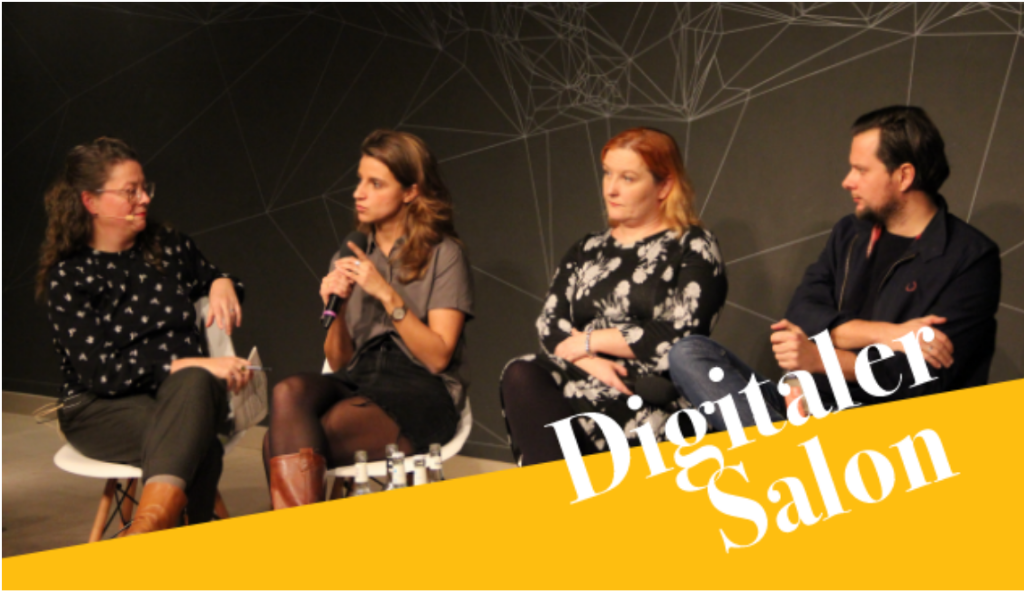
Once a month we publicly discuss the impact of digitalisation on the society. Therefore we invite special guests and engage in a dialogue with the audience.
NEWSLETTER
Be the first to learn about our new events and exciting research results.