

GenAI and the DSA’s Systemic Risk Framework
The Alexander von Humboldt Institute for Internet and Society in collaboration with the Leibniz Institute for Media Research | Hans-Bredow-Institut (HBI), and the DSA Observatory, with support from the Network of Centres (NoC), invites you to a new Learning Call Series on the impact of the Digital Services Act (DSA) on the future of global tech policy: Is the DSA a global censorship law or the necessary basis for rights-based content moderation? The event is part of a broader Learning Call Series addressing current topics related to the DSA. It will take place online and in English. This Learning Call is part of the DSA Research Network, funded by Stiftung Mercator.
GenAI and the DSA’s Systemic Risk Framework
Learning Call
Thursday, 25 June 2026 • 2.00–3.15 p.m. (CET)
Online (via Zoom)
In this session, we examine generative AI as a test case for the DSA’s systemic risk framework.
Speakers will discuss the nature of GenAI‑related risks and the governance mechanisms provided by the DSA and related legal frameworks to address them. Such risks may arise from the dissemination of synthetic and manipulated media, like deepfakes, on very large online platforms and search engines (VLOPSEs), as well as from new GenAI tools deployed by those very platforms in their content moderation systems or via embedded features like AI Overviews.
Broadly, the session will probe the potential and limits of the DSA’s platform‑centric, risk‑based approach to tackling the complex challenges posed by GenAI, and consider its interaction with other legal instruments (AI regulation, competition law, copyright). The session will also reflect on recent enforcement and policy developments, such as the potential VLOSE designation for services like ChatGPT, the Commission’s investigation into X’s deployment of Grok, the proposed Digital Omnibus on AI, and the review of the EU rules on copyright and AI.
Speakers
Sebastian Felix Schwemer is Professor of Law and Technology at BI Norwegian Business School and Associate Professor at the University of Copenhagen’s Centre for Information and Innovation Law (on leave), where he previously served as Director. He co-directs the Nordic Centre for Internet and Society and has advised national lawmakers and the European Commission on aspects related to his research. His work focuses on the intersection of (information) technology and law.
Buse Raziye Çetin is Head of AI Policy at AI Forensics, a European non-profit investigating algorithmic systems and platform power, and a lecturer in EU AI Policy at ELISAVA School of Engineering & Design. Her work focuses on AI governance, platform regulation, and the societal impacts of large-scale algorithmic systems, with particular attention to the EU AI Act, the Digital Services Act, and accountability mechanisms.
John Albert is an Associate Researcher at the Institute for Information Law (IViR) at the University of Amsterdam as well as the HIIG, and a contributing writer and editor for the DSA Observatory. His current research examines how platforms frame generative AI in their systemic risk assessment reports; he has previously written on the functioning of DSA audits and researcher access to platform data within the DSA’s systemic risk-management regime.
Moderator
João Pedro Quintais is Associate Professor at the Institute for Information Law (IViR) of the University of Amsterdam.
Registration
To participate in this event, please follow this link and register directly on the site of the DSA Observatory. You will receive the login details on the day of the event. If you have any questions or comments, please reach out to dsaobservatory-ivir@uva.nl.
About the Learning Call Series
In the Learning Call Series “A Global Censorship Law or Rights-Based Content Moderation?”, we explore the impact of the Digital Services Act (DSA) on the future of global technology policy. Across a set of focused sessions, experts examine whether restrictive regulatory models or rights-based approaches to platform governance are more likely to shape content moderation worldwide.
About the Network of Centers (NoC)
The NoC is a collaborative initiative among academic institutions with a focus on interdisciplinary research on the development, social impact, policy implications, and legal issues concerning the Internet. This collective aims to increase interoperability between participating centers in order to stimulate the creation of new cross-national, cross-disciplinary conversation, debate, teaching, learning, and engagement regarding the most pressing questions around new technologies, social change, and related policy and regulatory developments.
About the DSA Research Network
The DSA Research Network aims to establish a unique space for communication and collaboration on the implementation of the Digital Services Act, with a strong focus on making early recommendations on potential areas for reform. Following a network-based approach, the project sets out to add value to already existing initiatives that have been formed to accompany the process of implementation. By providing a platform for cross-sectoral dialogue between academics, practitioners, NGOs, and regulators, we facilitate the creation of actionable knowledge and foster a culture of collaboration.
Partner
The DSA Research Network is a collaboration between the Alexander von Humboldt Institute for Internet and Society, the Leibniz Institute for Media Research | Hans Bredow Institute, and the DSA Observatory, University of Amsterdam. It is funded by the Stiftung Mercator.

DIGITAL SOCIETY LECTURES
This high-profile lecture series thrives to develop a European perspective on the processes of transformation that our societies are currently undergoing.
DIGITALER SALON
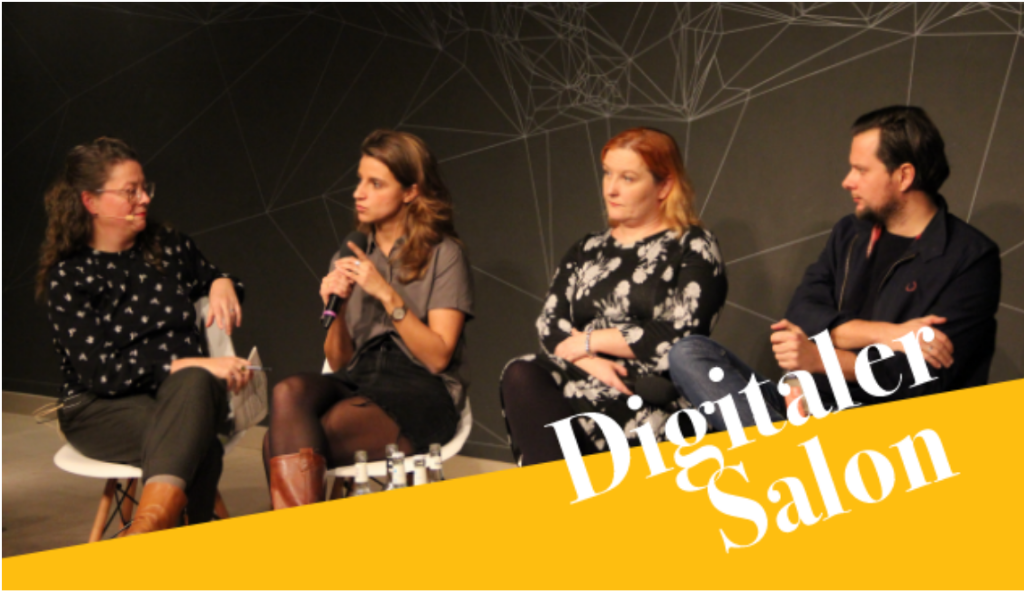
Once a month we publicly discuss the impact of digitalisation on the society. Therefore we invite special guests and engage in a dialogue with the audience.
NEWSLETTER
Be the first to learn about our new events and exciting research results.