

Dealing with hostility against science
KAPAZ Material collection
In an era marked by misinformation and populist narratives, science communication plays a crucial democratic role in bringing expert knowledge into public debates. Yet scientists must navigate polarised environments and may face hostility ranging from criticism and harassment to physical threats, sometimes leading to self-censorship that limits diverse perspectives in public discourse. That is why a team of researchers and practitioners from eight different organisations spent three years investigating these challenges in the Capacities and Competencies in Dealing with Hate Speech and Hostility towards Science (KAPAZ) network.
One of its key insights offers cautious optimism: while attacks are a real concern, severe incidents remain the exception. With the right preparation, institutional support and training, much can be done to address hostility effectively. To this end, KAPAZ has brought together its key findings in this collection as a lasting knowledge base for the science system. The resources were developed by the project's partner organisations. Whether you are a researcher navigating public discourse, an institution building support structures or a science communicator seeking practical tools – browse the resources below and find what you need.

Nataliia Sokolovska, Dr.

Capacities and competencies in dealing with hate speech and hostility towards science
The KAPAZ project develops strategies and practical tools to make the science system more resilient to hostility in public discourse.
Fact Sheet
Understanding holstility towards researchers
If you want to understand the scale and nature of hostility towards scientists, this is your starting point. Based on a survey of researchers in Germany, it provides empirical findings on how many researchers face attacks, which forms of hostility exist and what consequences they report.
Guidelines
Fortify research institutions
Designed for science communication managers and institutions, these guidelines support the development of effective prevention strategies, crisis management structures and training. They offer practical steps to assess threats, secure evidence and respond to attacks, tailored to the specific needs of research organisations.
Guidelines
Equip researchers
For researchers and science communicators navigating online hostility, these guidelines offer step-by-step guidance for recognising and handling escalating situations. They provide practical tools to assess threats, secure evidence, mobilise support networks and make informed decisions about how and when to engage publicly.
Guidlines
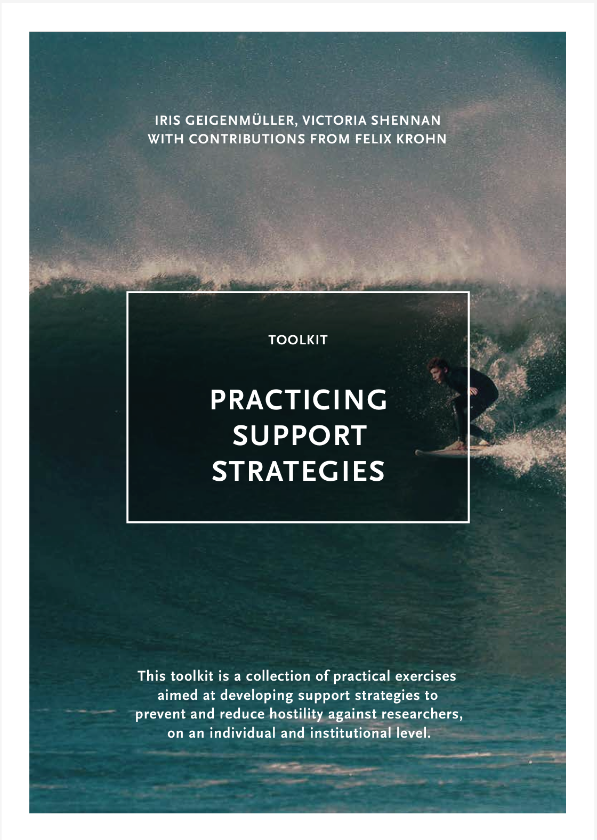
Toolkit
Practicing support strategies
Looking to build a culture of support within your institution or team, this toolkit offers nine adaptable exercises for workshops and training sessions. It covers awareness-raising, prevention and crisis response for science communicators, researchers and institutional leaders in any organisational context.
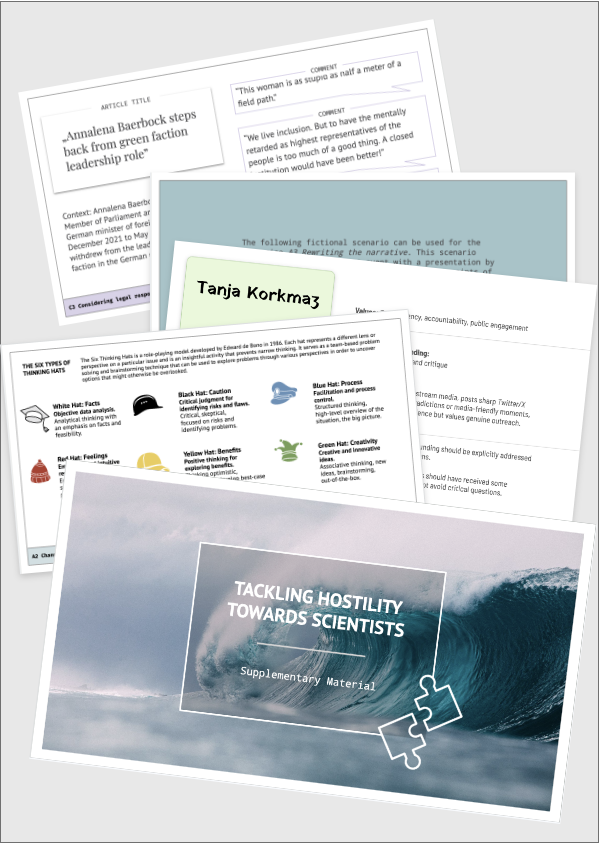
Resource deck
Facilitator guide and workshop materials
If you are delivering workshops or training on hostility towards scientists, these materials provide ready-to-use resources and practical guidance for facilitators. They include background information, exercises and coordination tools that are easily adaptable for a range of institutional and professional contexts.

Blog article
When scientists are targeted, what helps?
Institutions often applaud public engagement, until the backlash begins. Then what? At a Berlin workshop, researchers explored what concrete support structures are needed to move from awareness to action.

Blog article
How good science communication can support researchers in cases of hostility
Threats and attacks on researchers can lead them to self-isolate and retreat from public communication. We look at strategies to prevent this from happening.

Blog article
Science hostility: What we know and what we can do about it
What do we know about the scale and nature of hostility towards scientists – and what can be done about it? This article offers an overview of how KAPAZ contributes to countering hostility against researchers.
Special Issue: Scholars under Attack
This international essay collection in the Journal of Science Communication brings together empirical and theoretical contributions on how science hostility is experienced and navigated across very different contexts. With perspectives from Europe, the United States and the Majority World, it offers a nuanced and global view of attacks on researchers and science communicators.

Scicomm-Support
Researchers and science communicators who face attacks and hostility in their public communication can turn to this national helpline for free personal counselling, guidelines and training. As a KAPAZ project partner, it is committed to making the science system more resilient against hate speech and hostility towards science.

Blog Issue: Science under pressure
In liberal democracies around the globe, science and its institutional environment are increasingly under pressure. Universities face budget cuts, political interference and rising scrutiny, while digital platforms amplify disinformation and heighten the risks of public engagement. This ongoing blog issue on Elephant in the Lab collects perspectives on how researchers and institutions can respond to these structural challenges.

Research article
Published in the Journal of Public Understanding of Science, this study presents findings from a national survey of around 2,600 researchers in Germany on hostile acts in public communication. It offers a nuanced picture of how hostility is experienced across different disciplines, career stages and levels of media visibility – including which forms of hostility are most common and who is particularly at risk. The article is currently under peer review and forthcoming in 2026.