

Learning Call: Same same, but different?
Brazil’s digital legislation and the EU’s Digital Services Act
Das Alexander von Humboldt Institut für Internet und Gesellschaft (HIIG) lädt in Zusammenarbeit mit dem Leibniz-Institut für Medienforschung | Hans-Bredow-Institut (HBI) und dem DSA Observatory sowie mit Unterstützung des Network of Centres (NoC) zu einer neuen Reihe von Learning Calls ein. Diese befassen sich mit aktuellen Themen im Zusammenhang mit dem DSA. Die Reihe findet online und in englischer Sprache statt. Der Learning Call ist Teil des von der Stiftung Mercator finanzierten DSA Forschungsnetzwerks.
Same same, but different? Brazil’s digital legislation and the EU’s Digital Services Act
Learning Call
Tuesday, 3 November 2026 • 4.00–5.00 p.m. (CET)
Online (via Zoom)
Brazil and the European Union cooperate closely on digital policy. In June, they signed a Digital Partnership in Brasília, creating a framework for closer collaboration on areas including digital governance, connectivity, artificial intelligence and cybersecurity. Yet Brazil is not simply following the EU model: it is developing its own regulatory path for platform responsibility and the protection of children online.
In a landmark 2025 judgment, Brazil’s Federal Supreme Court (STF) found part of Article 19 of the Marco Civil da Internet (the country’s foundational internet law) to be unconstitutional. Put simply, Article 19 had largely protected platforms from being held civilly liable for unlawful content posted by their users unless the platform ignored a specific court order to remove it. A person harmed by a post would therefore usually need to obtain a judicial order before the platform faced civil liability for leaving the content online. The STF retained that court-order model for some ordinary disputes, but it made platforms more accountable for certain serious forms of illegal content. For these categories, platforms may now face liability when they fail to act after receiving a sufficiently specific notice—rather than only after a court order. The judgment also establishes heightened responsibilities for paid content and content amplified through artificial distribution networks, such as coordinated bot networks.
On 17 September 2025, President Luiz Inácio Lula da Silva signed Brazil’s first law specifically designed to protect children’s rights online: Estatuto Digital da Criança e do Adolescente (ECA Digital). The law requires online services to use reliable age-assurance measures to restrict minors’ access to inappropriate content, with safeguards varying according to the type of content involved. Services aimed at children and adolescents must also provide stronger privacy settings, address features that encourage compulsive use, and offer mechanisms for removing harmful content following notices from victims, prosecutors or representative organisations—without first requiring a court order. Brazil’s data-protection authority, the ANPD, is responsible for enforcing the law.
Compared to Brazil, the EU’s Digital Services Act (DSA) seems to take a preventive, risk-based approach: major platforms must identify and mitigate systemic risks under regulatory supervision. Brazil’s approach remains centred on civil liability for third-party content under Article 19, as reformulated by the Federal Supreme Court. However, the STF’s decision and subsequent regulation have also introduced systemic duties of care and ANPD supervision.
We will discuss the differences between the two approaches and their respective strengths and weaknesses. In which areas has Brazil adopted EU approaches? What could the EU learn from Brazil’s approach?
Speakers
Laíse Barbosa is a JSD Candidate at Stanford Law School and a JSM graduate from Stanford Law School (Class of 2024–2025). Her work focuses on technology, freedom of expression, and digital governance. She has worked across academic and advocacy spaces, with research experience at the Center for Technology and Society (CTS) at FGV Direito Rio, the Global Project Against Hate and Extremism (GPAHE), and the Office of the Special Rapporteur for Freedom of Expression at the Inter-American Commission on Human Rights (IACHR). She also holds a Master’s degree in Law from the Federal University of Paraná in Brazil, including a visiting period at the University of Graz in Austria, and a Bachelor of Laws from the State University of Ponta Grossa, Brazil.
Moderator
Prof. Dr. Matthias C. Kettemann is Head of Research for the New Technologies and the Future of Law research focus at the Alexander von Humboldt Institute for Internet and Society (HIIG). He teaches law and innovation at the University of Innsbruck and leads a research area on platform governance at the Leibniz Institute for Media Research | Hans-Bredow-Institut, Hamburg.
About the Learning Call Series
In this Learning Call Series, we explore the impact of the Digital Services Act (DSA) on the future of global technology policy. Across a set of focused sessions, experts examine whether restrictive regulatory models or rights-based approaches to platform governance are more likely to shape content moderation worldwide.
About the Network of Centers (NoC)
The NoC is a collaborative initiative among academic institutions with a focus on interdisciplinary research on the development, social impact, policy implications, and legal issues concerning the Internet. This collective aims to increase interoperability between participating centers in order to stimulate the creation of new cross-national, cross-disciplinary conversation, debate, teaching, learning, and engagement regarding the most pressing questions around new technologies, social change, and related policy and regulatory developments.
About the DSA Research Network
The DSA Research Network aims to establish a unique space for communication and collaboration on the implementation of the Digital Services Act, with a strong focus on making early recommendations on potential areas for reform. Following a network-based approach, the project sets out to add value to already existing initiatives that have been formed to accompany the process of implementation. By providing a platform for cross-sectoral dialogue between academics, practitioners, NGOs, and regulators, we facilitate the creation of actionable knowledge and foster a culture of collaboration.
Partners
The DSA Research Network is a collaboration between the Alexander von Humboldt Institute for Internet and Society, the Leibniz Institute for Media Research | Hans Bredow Institute, and the DSA Observatory, University of Amsterdam. It is funded by the Stiftung Mercator.

Registration
To participate in this event, please register using the form below.
You will receive the login details after registration.
If you have any questions or comments, please reach out to jella.ohnesorge@hiig.de
Buchungen
DIGITAL SOCIETY VORTRÄGE
Diese exklusive Vorlesungsreihe entwickelt eine europäische Perspektive zu den aktuellen Transformationsprozessen innerhalb unserer Gesellschaft.
DIGITALER SALON
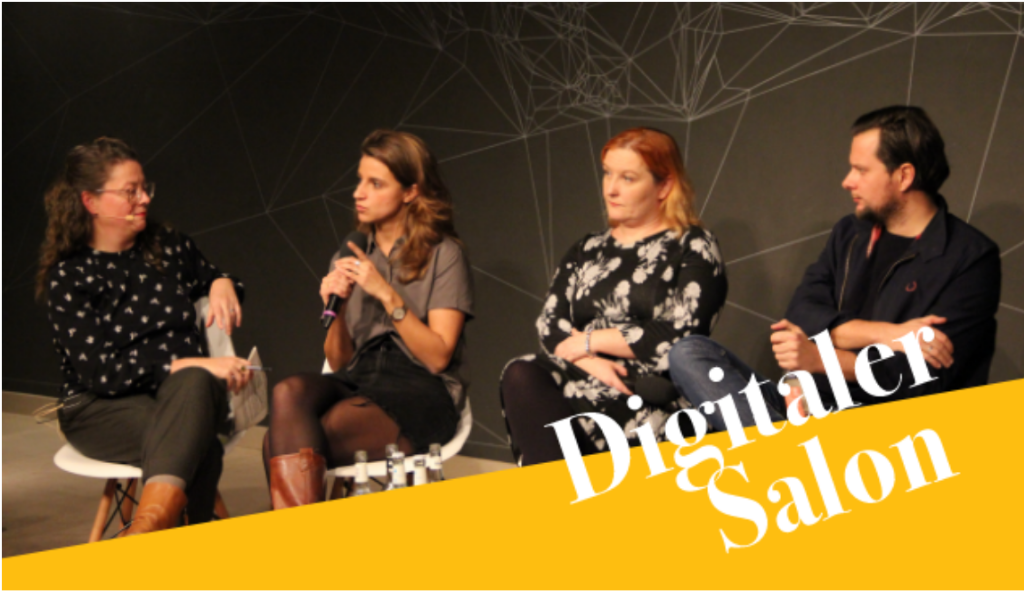
Einmal im Monat laden wir ausgewählte Gäste ein, um gemeinsam mit dem Publikum über die Auswirkungen der Digitalisierung auf die Gesellschaft zu sprechen.
NEWSLETTER
Erfahren Sie als Erstes über neue Events und spannende Forschungsergebnisse.